Since Meta launched the LCoS-powered Ray-Ban Display in September 2025, LCoS-based optical engines have entered the market spotlight. Despite renewed interest, this long-standing display technology still struggles with major hardware roadblocks. With new dominance at stake, leading manufacturers are racing to roll out the best LCoS optical engines in line with their distinct market positioning.
On the notification AR glasses front, LCoS optical engines have an edge in technological maturity, energy efficiency, and optical compatibility. Building on years of developing reflective liquid crystal displays and external light source systems, the industry is well-positioned for full-color LCoS-based optical engine deployment. LCoS technology consumes less power than its LEDoS counterparts when displaying high average pixel lit (APL) images. Additionally, due to its inherent polarized beam structure, LCoS technology can significantly reduce optical losses when integrated with waveguides, thereby enhancing overall luminous efficiency.
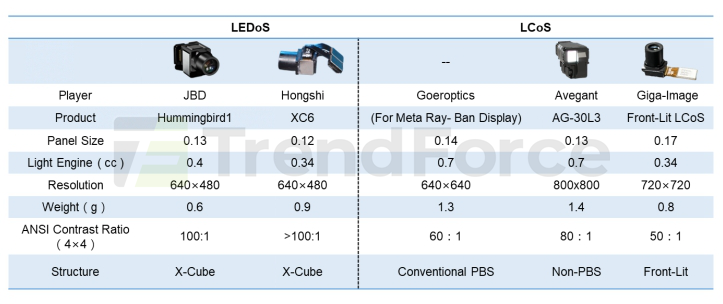
While promising to serve as the ultimate solution for notification AR glasses, LCoS technology still needs to address several challenges. The miniaturization of optical engines stands out as the most critical issue. Currently, mass-produced LCoS optical engines measures approximately 0.7 cc in volume, whereas full-color LEDoS engines have been miniaturized to as small as 0.4 cc. Moreover, the size of optical engines is closely related to the thickness of temple arms, overall weight, ergonomics, and aesthetic appeal. Therefore, all optical engine solutions are actively minimizing physical volume to accelerate AR glasses commercialization in the mass market.
Notably, LEDoS’s long-term roadmap is based on monolithic full-color display technology to further reduce the volume of optical engines. LEDoS-based solutions include vertical stacking, quantum dot (QD) color conversion, and InGaN-based red emitters. However, in the near term, the industry remains largely focused on X-Cube optical engines to fast-track industry-relevant products to market. By contrast, LCoS technology is pursuing divergent paths, with major manufacturers exploring distinct technological pathways to navigate a highly segmented and diverse competitive landscape in search of breakthroughs.
Driven by this dynamic, the industry is proposing innovative optical circuit designs, PBS (polarizing beam splitter) optimizations, and alternative solutions to inject growth momentum into LCoS technology. Himax Display, for example, recently introduced a Front-Lit LCoS architecture to compress engine volume to below 0.4cc. Meanwhile, startup Avegant has taken a more aggressive approach by removing the PBS from optical engine designs. The company has succeeded in reducing its engine volume from 1.4 cc to 0.7 cc, and has further addressed the long-standing issue of bulky temple bulges through its proprietary sideways projection design.
While LEDoS technology prioritizes steady progress, LCoS technology is leveraging its distinct features to aggressively break through the engine volume bottleneck. To bring all-day wearability into reality, the future AR glasses market will be led by pioneers who can achieve the optimal trade-off among form factor, power consumption, luminous efficiency, resolution, and cost.
Author: Estelle / TrendForce
TrendForce 2025 Near-Eye Display Market Trend and Technology Analysis
Publication Date : 29 August 2025
Language : Traditional Chinese / English
Format : PDF
Page Number: 168
|
If you would like to know more details , please contact:
|


