Metasurfaces—ultrathin optical structures that manipulate light—have been proposed as compact alternatives to conventional lenses, mirrors, and filters. Researchers have shown that they can shape, steer, and transform light in ways that would otherwise require much larger optical systems. Yet a major challenge has limited their wider adoption: once a metasurface is fabricated, its functionality is largely fixed. Changing its optical properties often requires designing and manufacturing an entirely new device.
Researchers recently demonstrated a different approach: a programmable "virtual metasurface" whose optical function can be changed in real time. Instead of relying on permanently patterned nanostructures, the system uses a spatial light modulator (SLM) to create software-defined optical patterns that can be updated on millisecond timescales.
As reported in Advanced Photonics Nexus, the system is built around a lithium niobate film just 600 nanometers thick. Instead of physically sculpting the film with nanoscale features, the researchers project programmable phase patterns onto a pump laser beam using the SLM. These patterns act as virtual optical components, effectively creating a reconfigurable metasurface without altering the film itself.
The international research team — from Nottingham Trent University, the University of Brescia, and Nankai University — used the platform to tackle a longstanding challenge in imaging: converting infrared images into visible light. Conventional infrared cameras rely on specialized semiconductor detectors that are expensive, often provide lower resolution than visible-light cameras, and typically operate over only a limited spectral range. By contrast, converting infrared information into visible wavelengths allows researchers to take advantage of mature, visible-light cameras.
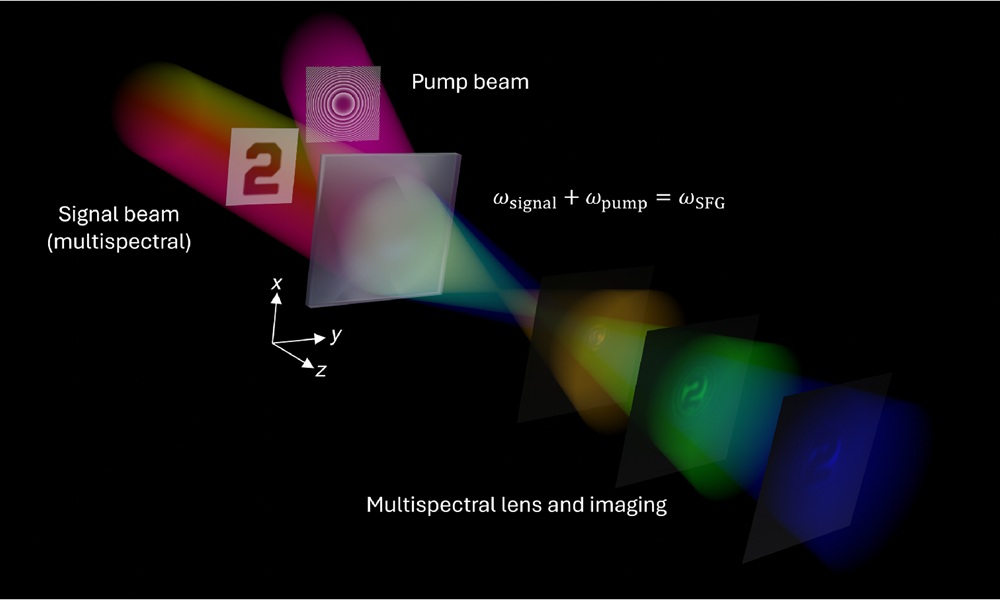
To achieve this conversion, the team employed a nonlinear optical process known as sum-frequency generation. An infrared signal beam carrying image information was combined with a second laser beam inside the lithium niobate film. The interaction generated visible light whose properties were determined by the pattern encoded on the pump beam. Because the virtual metasurface exists as a software-controlled phase pattern rather than a fixed physical structure, its behavior can be changed on demand.
A key demonstration was the creation of a programmable virtual lens. By applying a Fresnel-zone phase pattern to the pump beam, the researchers controlled where the generated visible light came into focus. Unlike a conventional lens, whose focal length is fixed by its physical shape, the virtual lens could be adjusted electronically. Changing the phase pattern altered the focal length without moving or replacing any optical components.
Experiments confirmed that the focusing behavior matched theoretical predictions. The team showed that increasing the size of the programmed lens pattern produced longer focal lengths, while changing the wavelength of the incoming infrared signal also shifted the focus position. Visible images generated from infrared light could therefore be brought into focus at different locations simply by changing either the software pattern or the input wavelength.
The wavelength-dependent focusing also enabled multispectral imaging. Infrared signals carrying image information at different wavelengths naturally formed images at different focal planes, allowing wavelength information to be separated spatially. Such systems could potentially distinguish information carried by multiple infrared wavelengths without requiring separate detectors for each spectral band.
To demonstrate the concept, the researchers imaged an infrared target shaped like the number "2." The system converted the infrared image into visible light that could be recorded by a standard CMOS camera. As the infrared wavelength was tuned, the image appeared at different focal positions, demonstrating simultaneous wavelength conversion and spectral discrimination.
The work also showed that the system preserves information about the direction of incoming light during the conversion process. This capability is important for imaging applications because it allows spatial information from an infrared scene to be transferred accurately into the visible domain.
The study demonstrates that a software-defined metasurface can convert infrared images into visible light while simultaneously controlling their focus. Because the system can be reconfigured electronically and operates across multiple wavelengths, it offers a new approach for infrared imaging and wavefront control. Further work will be needed to improve conversion efficiency and evaluate performance in practical applications, but the results establish a foundation for programmable optical systems based on virtual metasurfaces.
(Photo credit: Zheng et al., doi 10.1117/1.APN.5.4.046024)
TrendForce 2025 Near-Eye Display Market Trend and Technology Analysis
Publication Date : 29 August 2025
Language : Traditional Chinese / English
Format : PDF
Page Number: 168
|
If you would like to know more details , please contact:
|


