Japanese Researchers Use Sputtering Method to form GaN LEDs on Glass Substrate

A team of researchers in Japan have developed a new technology for creating GaN LEDs on glass substrate, according to Japanese media source Nikkei Technology. 

Headed by Professor Hiroshi Fujioka from the Institute of Industrial Science at the University of Tokyo, the team’s development can not only cut manufacturing costs, but also help to actualize OLED light panels. 
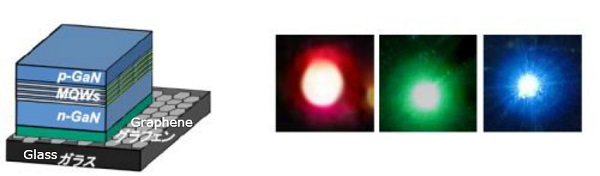
The structure of the new LED formed on a glass substrate (left) and LED elements emitting red (R), green (G) and blue (B) lights (photo courtesy of Institute of Industrial Science, The University of Tokyo/ Nikkei Technology)

A sputtering method is used to transcribe the GaN LEDs onto the glass substrate. The team has not yet measures luminous efficiency or external quantum efficiency for any single color. They are currently testing the efficiency of the internal quantum at low temperatures, according to Nikkei. 

“The internal quantum efficiency is several tens of percent lower than that of an LED formed on a sapphire substrate,” said Fukioka. 

To read the abstract for the research team’s thesis published in Scientific Reports, please click here: Fabrication of full-color InGaN-based light-emitting diodes on amorphous substrates by pulsed sputtering

Disclaimers of Warranties
1. The website does not warrant the following:
1.1 The services from the website meets your requirement;
1.2 The accuracy, completeness, or timeliness of the service;
1.3 The accuracy, reliability of conclusions drawn from using the service;
1.4 The accuracy, completeness, or timeliness, or security of any information that you download from the website
2. The services provided by the website is intended for your reference only. The website shall be not be responsible for investment decisions, damages, or other losses resulting from use of the website or the information contained therein<
Proprietary Rights
You may not reproduce, modify, create derivative works from, display, perform, publish, distribute, disseminate, broadcast or circulate to any third party, any materials contained on the services without the express prior written consent of the website or its legal owner.
Ennostar today announced a breakthrough in Micro LED optical communications. The company’s R&D team has increased the single-channel -3 dB modulation bandwidth of its blue Micro LED to 2.1 GHz at a current density of 2 kA/cm². The ... READ MORE

Daktronics of Brookings, South Dakota, was asked to refresh the video display and control system at the University of Texas, El Paso’s (UTEP) Sun Bowl Stadium. The display improved resolution 4.5 times the previous screen using the Daktr... READ MORE