SCHOTT is a reliable global technology group and advanced materials producer founded in 1884, with more than 17,400 employees across 30 countries. SCHOTT keeps broadening its product lines into different applications, including semiconductors, datacom, automotive, healthcare, and AR. TrendForce recently had the opportunity to interview Jonas, Head of Product Management and Strategy for Augmented Reality, and Christian, Head of Global Sales Augmented Reality at SCHOTT Business Unit Advanced Optics. They discussed the company's current developments and provided a clear overview of SCHOTT's geometric waveguide technology and its diffractive waveguide substrate, SCHOTT RealView®.

Christian, Head of Global Sales Augmented Reality (Left)
Jonas, Head of Product Management and Strategy for Augmented Reality (Right)
Surface Relief Grating Waveguide Substrate – SCHOTT RealView®
Since 2016, SCHOTT has been conducting R&D on high-index glass for surface relief grating (SRG) waveguides, a type of diffractive waveguide technology, and in 2018 the company established a dedicated SCHOTT RealView® wafer manufacturing site in China. Today, SCHOTT operates a highly integrated, end-to-end manufacturing workflow for its SCHOTT RealView® glass wafers. As Jonas explained, the process begins at the group's headquarters in Germany, which handles upstream R&D and high-precision glass melting at scale. The premium optical glass is then transferred to SCHOTT's advanced facilities in China for downstream processing to produce market-ready wafers. In terms of specifications, Jonas noted that SCHOTT currently offers 6-inch, 8-inch, and 12-inch wafers, with thickness ≥ 250µm and flatness < 200nm. To date, cumulative shipments have exceeded 500,000 wafers, with 8-inch being the vast majority. Looking ahead, SCHOTT is developing high-index and low-density glasses. Its latest product launch, SCHOTT RealView® 2.0 lightweight, showcases these advancements and combines a refractive index in the range of 2.0 with a density reduced to < 4 g/cm³ while maintaining high mechanical stability.
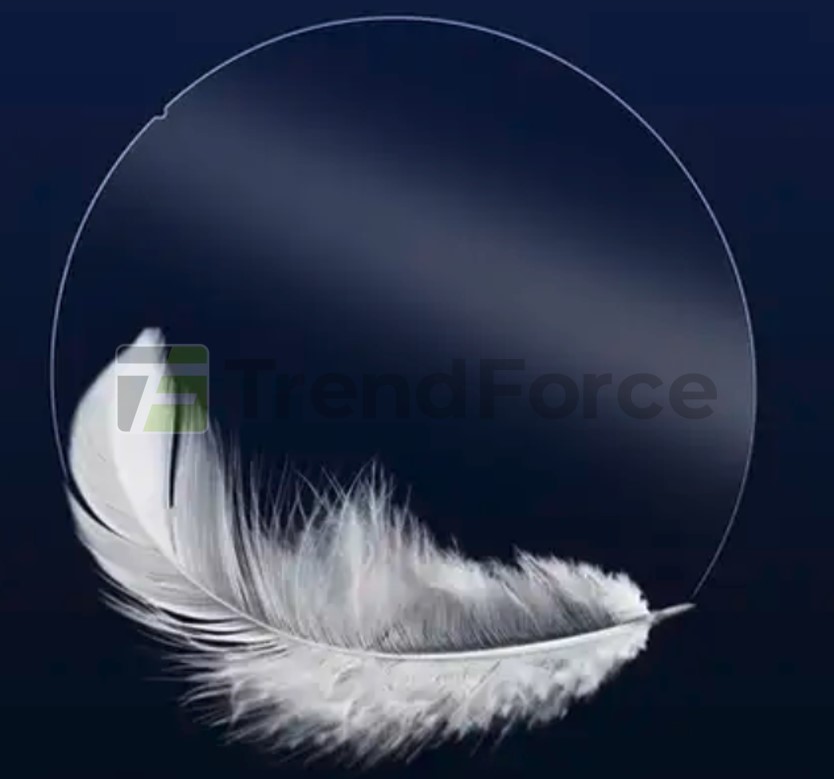
SCHOTT RealView® 2.0 lightweight
When compared to other waveguide substrates, SiC has a lower density and offers huge potential for a large FoV; however, it is also very brittle, difficult to process, and expensive at the same time. Resin, meanwhile, is lower in cost and lighter in weight than other materials, but it is impossible to achieve both high transmittance and a high refractive index simultaneously — image quality must be compromised as a result. Material science in this field involves a tradeoff among multiple indicators, such as refractive index, transmittance, mechanical stability, and manufacturability at scale. Against this backdrop, SCHOTT still believes that glass substrates — offering a high refractive index, strong transmittance, high mechanical strength, and proven mass-production capability — achieve a combination of properties that will be hard for other materials to match.
Geometric Reflective Waveguide
Since 2019, SCHOTT has been developing its geometric reflective waveguide (GRWG) technology in cooperation with Lumus, the pioneers of this technology. Jonas shared updates on the development of SCHOTT's geometric reflective waveguides, which are now in mass production. He emphasized SCHOTT's globally distributed manufacturing network, spanning R&D to final fabrication for geometric reflective waveguides, which allows the company to deliver its waveguides with greater confidence. Specifically, SCHOTT conducts upstream optical glass R&D and melting at its headquarters in Germany, performs coating development in Switzerland, manufactures the glass base in China, and carries out application-level R&D and waveguide fabrication at its Penang and Kulim facilities in Malaysia. By expanding its production capacity, SCHOTT anticipates that the annual capacity of its Kulim facility will reach a target of approximately 5 million pieces for geometric reflective waveguides. The next-generation products will feature fields of view (FoVs) of over 70° and significantly reduced thicknesses of less than 1 mm.
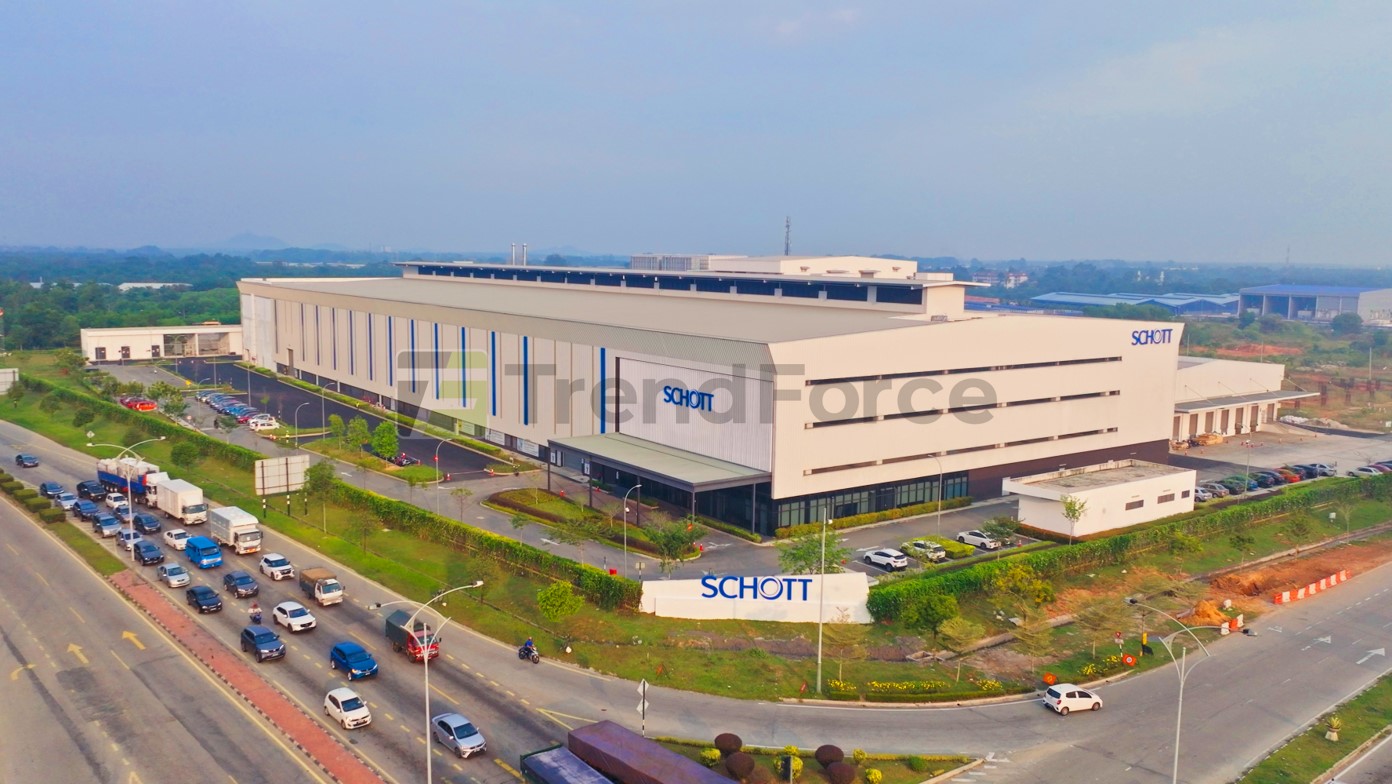
SCHOTT's geometric reflective waveguide manufacturing facility in Kulim (Image: SCHOTT)
Comparing the two waveguide technologies, SCHOTT believes that neither surface relief grating waveguide nor geometric waveguide will monopolize the market; instead, each will find its own application area. Surface relief grating waveguide technology is better suited to lower-FoV, or monochromatic applications, while geometric reflective waveguide is more suitable for a wider-FoV range and full-color applications thanks to its superior color uniformity, light efficiency, and reduced light leakage. With its dual-track strategy, SCHOTT is positioning itself as a comprehensive optical display partner across the AR near-eye display market, rather than betting on a single winning technology.
Author: Estelle / TrendForce
TrendForce 2025 Near-Eye Display Market Trend and Technology Analysis
Publication Date : 29 August 2025
Language : Traditional Chinese / English
Format : PDF
Page Number: 168
|
If you would like to know more details , please contact:
|


