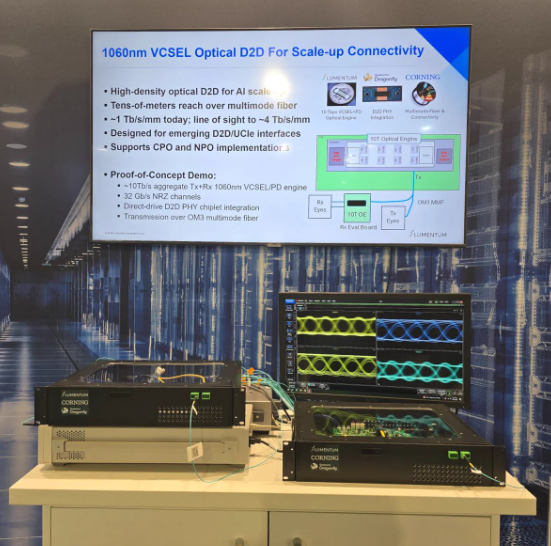
Lumentum Holdings Inc. (“Lumentum”) today announced plans for a joint demonstration together with Qualcomm Technologies, Inc. and Corning Incorporated (NYSE: GLW) of a high-density die-to-die (D2D) optical interconnect showcase for AI scale-up architectures at ECOC 2026. The board-level demonstration will combine a D2D interface IP subsystem from Qualcomm Technologies with Lumentum’s VCSEL-based optical interconnect platform and Corning multimode fiber connectivity. Attendees can see the demonstration at Lumentum stand #2050 and at Qualcomm Technologies’ stand #1050 / MB28 during ECOC 2026 in Málaga, Spain.
The demonstration will showcase a massively parallel optical D2D architecture designed for future co-packaged optics (CPO) and near-packaged optics (NPO) implementations supporting emerging D2D interfaces such as UCIe. By extending high-density D2D connectivity over optical links spanning tens of meters—while maintaining low latency and power consumption—the architecture enables highly scalable bandwidth density as AI systems drive interconnect requirements beyond the practical limits of today’s electrical connectivity.
Qualcomm Technologies’ D2D interface technology is designed to optimize power and area while enabling efficient direct-drive optical connectivity and preserving the benefits of high bandwidth density and low power. The proof-of-concept configuration being demonstrated uses optical channels operating at 32 Gb/s NRZ, to show how the massively parallel architecture can scale through higher channel counts and increasing per-lane data rates. The architecture is designed to support approximately 1 Tb/s/mm of shoreline bandwidth density today, with line of sight to approximately 4 Tb/s/mm through higher lane rates and increased channel density.
The optical interconnect leverages Lumentum’s optical engine based on advanced-packaged 1060 nm VCSEL technology, with approximately 10 Tb/s of aggregate transmit and receive capacity and high-density two-dimensional VCSEL and photodetector arrays with backside lens technology. Built on Lumentum’s ultra-high-volume 3D sensing manufacturing base, the platform is designed to support high shoreline bandwidth density, strong signal integrity, and energy-efficient optical connectivity for board-level and system-level AI scale-up architectures.
Corning’s multimode fiber glass ferrules will provide the high-density fiber connectivity used in the demonstration, highlighting the importance of fiber density as optical links increasingly move closer to compute devices and advanced packaging environments.
“This demonstration shows how Lumentum’s 1060 nm VCSEL platform can bring high-density optical connectivity closer to AI compute,” said Matt Sysak, Chief Technology Officer, Lumentum. By combining advanced VCSEL packaging with Qualcomm Technologies’ D2D interface technology and Corning’s fiber connectivity, we are showing a practical path toward compact, energy-efficient optical D2D links for next-generation AI scale-up architectures.”
“AI scale-up requires die-to-die connectivity that delivers high bandwidth density while minimizing latency, power, and area,” said Tony Chan Carusone, SVP, Technology, Qualcomm Technologies, Inc. This collaboration shows how Qualcomm Technologies’ D2D interface technology can extend those capabilities into optical links for future AI system architectures.”
“As optical links move closer to compute devices, fiber connectivity must support increasing density, precision, and scalability,” said Claude Echahamian, Vice President and General Manager, Emerging Businesses and EMEA, Corning Optical Communications. “Corning’s multimode fiber solutions and industry-leading MMC connectivity help enable this demonstration and support the evolution of high-density optical interconnects for AI infrastructure.”
(Photo credit: Lumentum)
TrendForce 2026 Infrared Sensing Application Market and Branding Strategies
Release: 01 January 2026
Format: PDF / EXCEL
Language: Traditional Chinese / English
Page: 168
|
If you would like to know more details , please contact:
|


