AR glasses are increasingly recognized as the next-generation compute platform, attracting investment from multiple international tech giants in related product development over recent years. However, as AR display technologies advance toward commercialization, the inefficiency of red Micro LEDs has become a critical bottleneck for the industry’s development.
In AR near-eye display structures, display panels are required to deliver high resolution and brightness within an extremely small size. Micro LEDs, characterized by their high brightness, efficiency, and product lifespan, are commonly viewed as a promising technology choice for future AR displays. Nonetheless, as Micro LED pixel sizes continue to shrink, red light-emitting components are suffering from rapidly deteriorating efficiency, posing significant challenges to screen brightness and power management. Currently, red light performance issues have become a major bottleneck for the commercialization of AR display technologies.
Porotech is among the select few market players committed to developing InGaN-based red Micro LED technology and actively involved in the technology’s industrial scaling. In a recent exclusive interview, TrendForce spoke with Porotech’s technical team to explore possible solutions for red Micro LED technologies.
InGaN as the New Frontier for Red Micro LEDs amid Traditional Material Constraints
Currently, there are two major material solutions for red Micro LED technologies:
-
Quaternary AlInGaP-based red Micro LEDs
-
Ternary InGaN-based red Micro LEDs
AlInGaP-based red LED technology is still commonplace in the market at this stage. Nonetheless, with shrinking pixel sizes, its external quantum efficiency (EQE) is on a steep decline due to increasing sidewall defects and surface recombination effects, further hindering the technology’s use in high-resolution AR display applications.
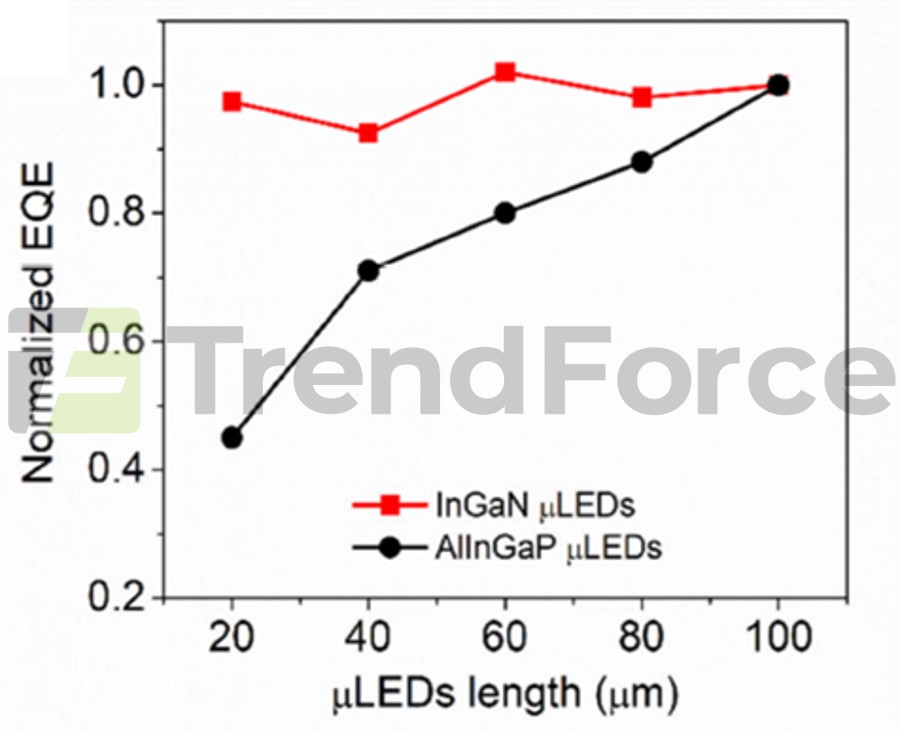
Declining EQE During Red Micro LED Scaling
Porotech’s technical team indicated that, compared with traditional AlInGaP materials, InGaN-based red Micro LED technology has the potential to maintain higher efficiency under device miniaturization. Therefore, it is widely viewed as a promising route for AR Micro LED displays.
Moreover, InGaN-based red-emitting devices exhibit higher stability under high operating temperatures. In an 85°C testing environment, these InGaN components sustain relatively consistent optical output when operating at high brightness and a high current density.
-
The efficiency drop of InGaN red LEDs is about 10%–15%
-
The efficiency drop of AlInGaP red LEDs is about 50%–60%
That said, extending the InGaN-based emission spectrum from blue light to red light requires an indium-rich material mix. However, higher indium content often leads to technical challenges, including lattice mismatch stress, wavelength control, and blueshifts under high current density operation.
Therefore, achieving high-efficiency InGaN red light has long been considered one of the critical technical challenges in the Micro LED industry.
PoroGaN® and SpectraCore® Technologies Overcome InGaN Red Light-Emitting Limitations
To address the material limitations of high-indium InGaN growth, Porotech developed the PoroGaN® epitaxy technology. With a specialized GaN-based structural engineering design, this technology enables stress relaxation during the growth of indium-rich materials while improving material quality and luminous efficacy.
Based on this material platform, Porotech further developed the SpectraCore® optical architecture. Porotech’s team indicated that this architecture is engineered to optimize the optical characteristics of InGaN-based red light, achieving significant improvements in both spectrum control and output power for optical devices.
With the SpectraCore® technology, Porotech’s InGaN red Micro LEDs can achieve:
-
A full width at half maximum (FWHM) less than 30nm
-
A beam angle smaller than 60°
-
Wavelength shifts below 5nm under high and low current operations
These features make InGaN red Micro LEDs a more effective display solution that meets the requirements of brightness, color purity, and optical control capabilities.
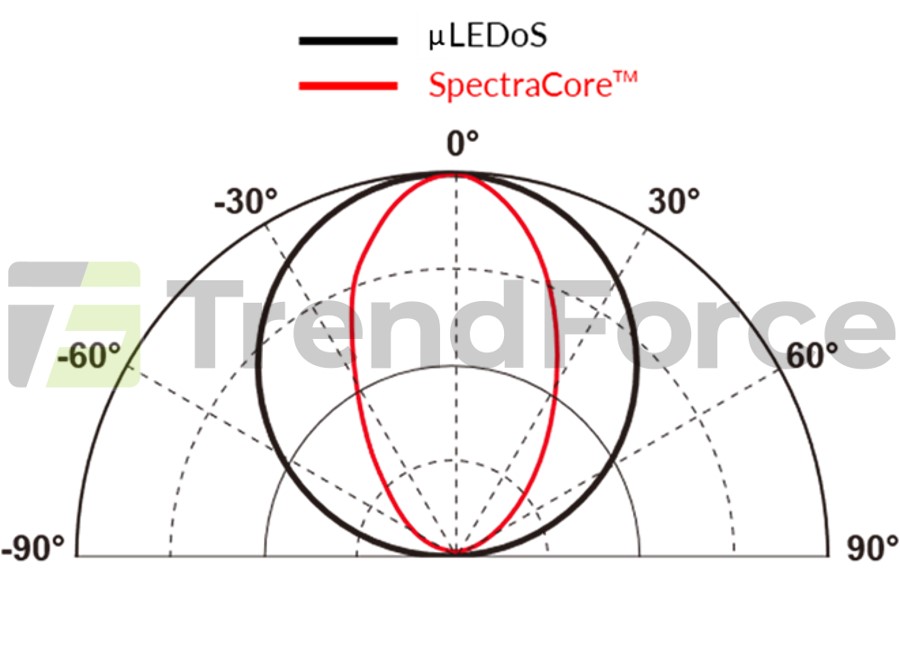
Even without Micro Lens (µLens), their beam angles can still be narrowed to 60°
“In AR Micro LED display applications, red light efficiency and optical control capabilities will directly impact the overall display performance,” said Porotech’s team.
Partnering with Foxconn to Establish a One-Stop Supply Chain for AR Micro LED Mass Production
Apart from material and component technologies, Micro LED volume production capabilities are also a critical lever for the industry’s development.
Porotech implements an 8-inch GaN-on-Si Micro LED wafer platform and leverages the combination of hybrid bonding technology and CMOS-driven chips to build a semiconductor-compatible LEDoS display process flow. Compared with conventional 4-inch or 6-inch substrate processes commonly seen in the LED industry, this semiconductor process can significantly improve manufacturing precision and production efficiency, further empowering continuous pixel scaling in the future. To accelerate commercialization, Porotech and Foxconn formed an AR display technology alliance to integrate multiple industry partners and navigate customer needs with agility. This partnership includes:
-
Porotech: Epitaxy and Micro LED component design
-
Foxconn: Hybrid bonding process integration
-
Rayprus: Optical engine packaging
-
GIS: Optical and module integration
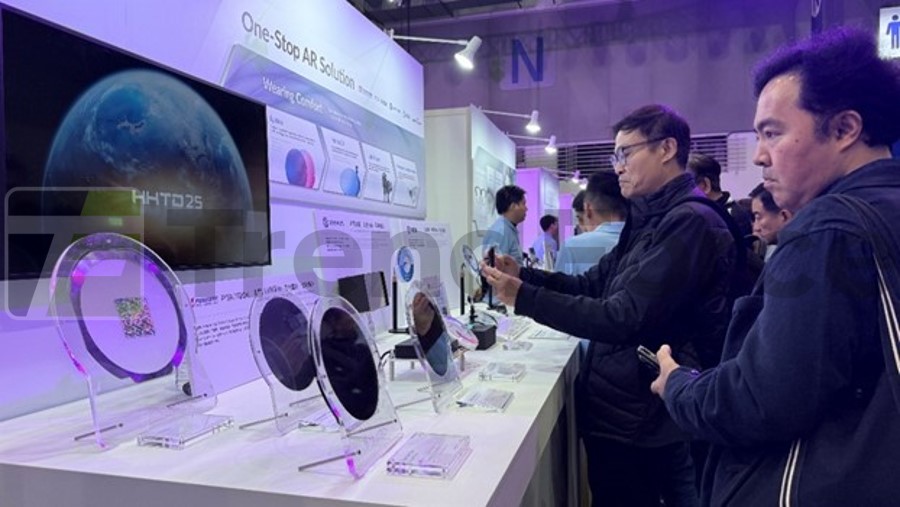
Porotech and Industry Partners Unveil Micro LED AR Display Solutions
Through such vertical collaboration in the industry, Porotech is progressively establishing an end-to-end supply chain dedicated to AR Micro LEDs.
Moreover, the company is planning to deploy a 12-inch GaN-on-Si epitaxy technology to further enable capacity scaling and cost reductions.
Pixel Pitch Scaling Paves the Way for High-Resolution AR Displays
Porotech has achieved a 2.5µm pixel pitch for pixel array mass production, along with a successful lab demonstration of 1.8µm-pitch pixel arrays by its R&D team. Such pixel density is equivalent to that of an approximately 0.1-inch Micro LED display with a WXGA resolution, meeting AR near-eye display requirements for high pixel density and enhanced resolution.
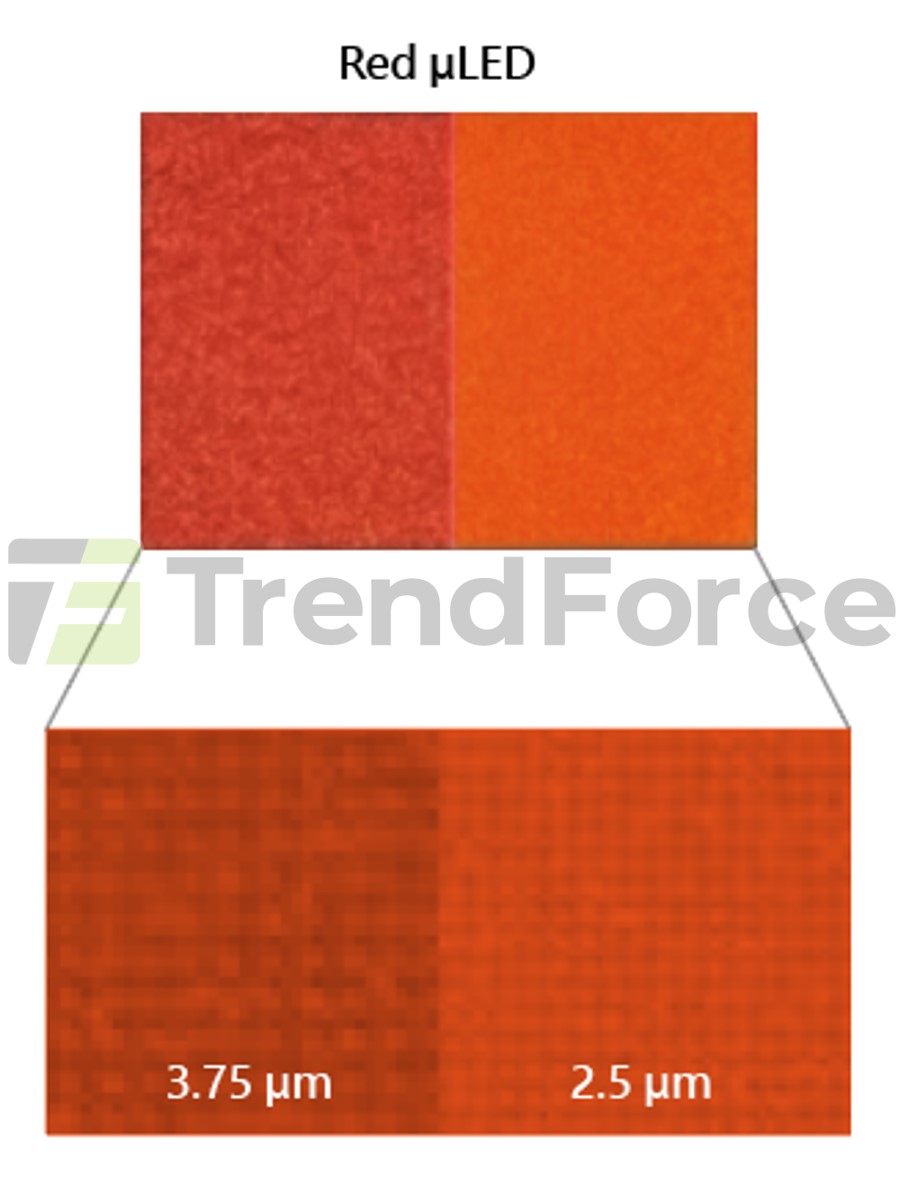
Comparisons of different µLED pixel pitches
Toward AR Display Commercialization
AR glasses are increasingly engineered for lightweight designs and consumer adoption, resulting in escalating demands for display component improvements in brightness, efficiency, resolution, and power consumption. With superior brightness, efficiency, and longevity, Micro LEDs are widely seen as a cornerstone technology for AR near-eye display development.
During this interview, Porotech’s team suggested, “If InGaN-based red light-emitting technology continues to overcome material and process limitations, it has the potential to become a critical pathway for AR Micro LED displays.” Based on its PoroGaN® and SpectraCore® technology platforms, the company is also exploring opportunities to apply its photonic technologies to high-speed applications, such as optical communications and co-packaged optics (CPO), aligning with the growing demands of data connectivity and computing power in the AI era.
Porotech further noted that AR displays will be one of the major applications for InGaN Micro LED technologies during early development. Leveraging its InGaN red light-emitting technology, semiconductor processing platform, and ever-improving pixel scaling capabilities, the company aims to develop Micro LED solutions featuring both high resolution and superior efficiency for the AR display industry, while accelerating AR glasses development toward more lightweight designs and mass-market adoption.
“The maturity of Micro LED technology will not only bring AR display technologies to the commercial market but also promise to play a crucial role in optical communications and AI photonics,” Porotech’s team concluded.
Author: Estelle / TrendForce
TrendForce 2025 Near-Eye Display Market Trend and Technology Analysis
Publication Date : 29 August 2025
Language : Traditional Chinese / English
Format : PDF
Page Number: 168
TrendForce 2025 Micro LED Display and Non-Display Application Market Analysis
Release: 29 May / 30 November 2025
Languages: Traditional Chinese / English
Format: PDF
Page: 119
|
If you would like to know more details , please contact:
|


