Amid the AI data center expansion and computing arms race, NVIDIA, Google, and Meta have strategically secured production capacity from EML and CW-DFB LD suppliers. This move underscores the strategic importance of laser diodes in advancing optical communication technology while driving demand for high-power products with superior thermal capabilities. Tong Hsing Electronic, a world-renowned ceramic substrate supplier, has introduced multiple products for customers to explore use cases in the optical communications, high-voltage direct current (HVDC), and low Earth orbit satellite domains. Recently, TrendForce had the opportunity to speak with Heinz Ru, President of Tong Hsing Electronic, in an exclusive interview. President Ru shared the company’s progress in three critical applications, namely optical communications, HVDC systems, and low Earth orbit satellites, along with its vision and outlook.
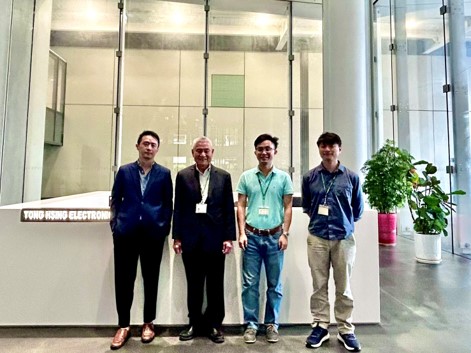
Caption: Heinz Ru (second from left), President of Tong Hsing Electronic, with the R&D and sales team.
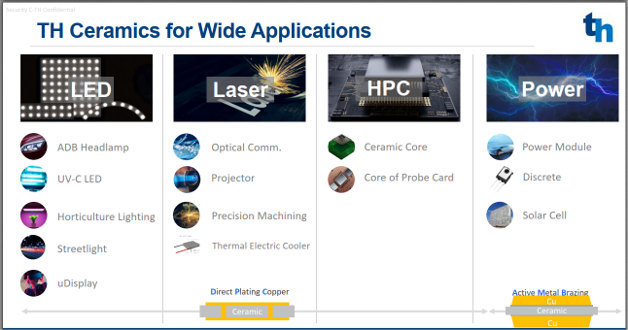
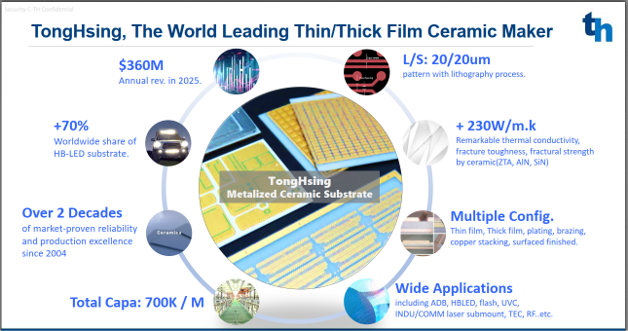
Heinz Ru said that Tong Hsing has a long track record in developing direct plated copper (DPC) technology since 2004. With over 20 years of expertise, the company has leveraged its initial offerings, such as LED high-power general lighting, automotive headlamps, and handset flash LEDs to gain strong support and recognition from customers in Europe, the US, and Japan. Moreover, it has now successfully expanded into cutting-edge high-growth applications, including industrial lasers, optical communication lasers, HVDC systems, and low Earth orbit satellites.
I. Optical Communications
1. Ceramic Substrates for Laser Diodes (EML/CW-DFB LD)
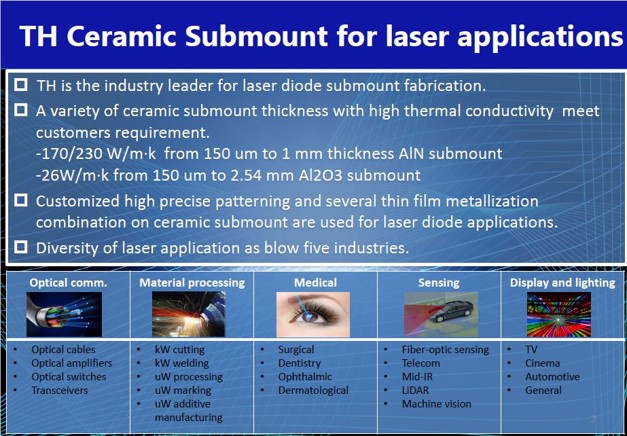
In the optical communication market, as individual EML/CW-DFB laser diodes achieve higher transmission rates, heat dissipation performance has become a critical evaluation indicator for ceramic substrates. Tong Hsing has drawn on its extensive experience with industrial lasers and projector lasers to optical communication applications. Specifically, using physical vapor deposition (PVD), the company achieves high precision in growing a gold-tin (AuSn) alloy layer on top of an aluminum nitride (AlN) submount as a thin‑film laser submount. Excellent electrical conductivity and die-attach performance are achieved, both of which are key enablers of effective heat dissipation in laser diodes. In practical use cases with its U.S. customers, Tong Hsing has demonstrated thermal conductivity as high as 230 W/m·K, enabling single laser diodes to deliver 35–42W of output power. Currently, Tong Hsing has positioned 400 Gbps transceivers as its mass-production workhorse. Looking to 2026, the company has identified 800 Gbps transceivers as a key growth driver, while mobilizing its R&D efforts to deliver 1.6 Tbps solutions.
2. Ceramic Core Interposers
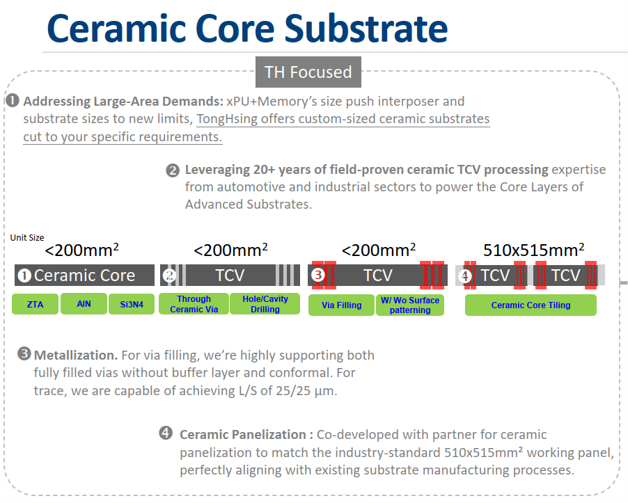
Heinz Ru reiterated that ceramic cores are Tong Hsing’s second growth engine. In pursuit of larger dimensions, ASICs have been increasingly challenged by their bonding strength with advanced substrates due to differences in coefficients of thermal expansion (CTE). Leveraging its mature and industry-proven direct plated copper (DPC) process, Tong Hsing has introduced ceramic cores as interposers. Ceramic cores can effectively mitigate the stress at the interface with ABF substrates, while featuring a CTE closer to silicon. In ongoing customer demonstrations, the company has supplied ceramic core products with 32×32 channels.
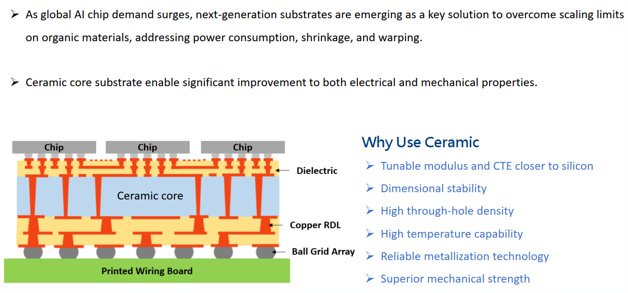
Notably, ceramic cores are also a promising solution for IC substrates. Compared with PCBs, ceramic cores offer superior characteristics, such as higher flatness, higher thermal resistance, and a lower CTE. These features can significantly enhance device performance and reliability in silicon photonics for high-speed optical communications. In particular, through unlimited splicing, ceramic cores can achieve a large surface area of up to 510 × 515 mm², on par with glass substrates.
3. Thermoelectric Cooling (TEC)
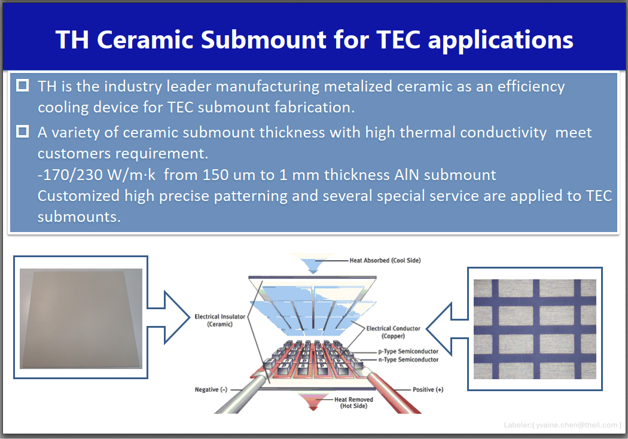
Thermoelectric cooling (TEC) is a technology based on the Peltier effect in semiconductor materials, enabling active heat transfer from one location to another. Heinz Ru noted that thermoelectric cooling (TEC) has long been employed in products requiring small-area cooling, such as mini fridges. In AI data centers, however, the adoption of high-power laser diodes has elevated the requirements for cooling performance, thermal stability, and low thermal resistance. For TEC applications, Tong Hsing has developed aluminum nitride (AlN) submounts with stable thermal conductivity reaching 230 W/m·K, while enabling 150µm thin films with precise thickness control, thereby minimizing resistance imbalance. Moreover, the company has developed a thick gold (Au) process to prevent metallization from sulfur and moisture erosion. For applications tailored for US customers, the company enables effective thermoelectric cooling by sandwiching laser diodes (EML/CW-DFB LD) between a top and a bottom AlN submount. For higher transmission rates and power output, more efficient cooling can be achieved through stacking technology.
II. High-Voltage Direct Current (HVDC) Systems
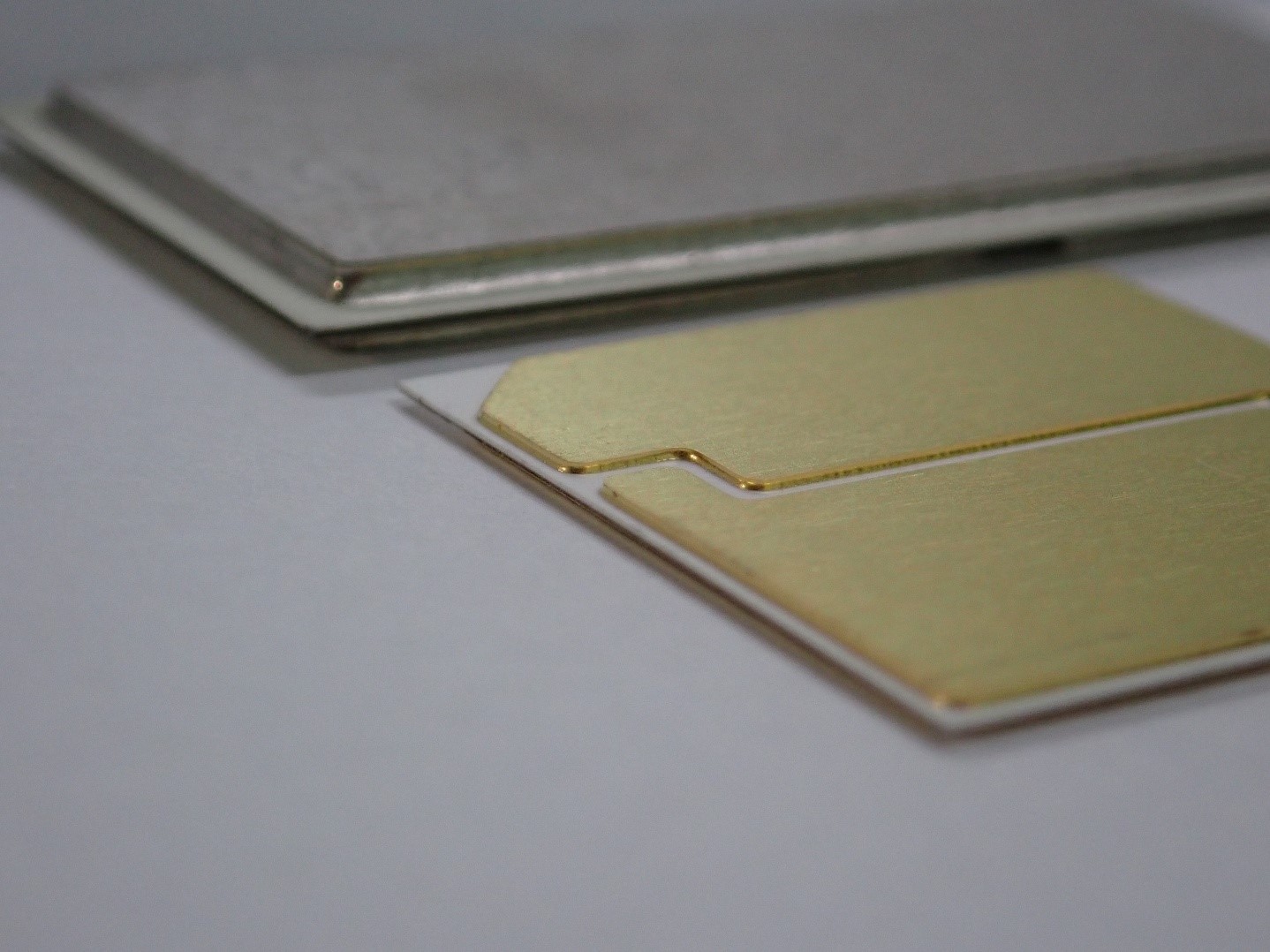
While delivering higher energy efficiency, 800V HVDC systems are more prone to DC arc flash events. During equipment failure, insulation breakdown, or operational errors, HVDC systems might produce arc discharges and high-temperature plasma, thereby damaging equipment and endangering personnel safety. Heinz Ru noted that 800V HVDC systems are an inevitable trend amid the transition from 480V AC to 800V DC server racks. To meet this demand, Tong Hsing has incorporated IBC (intermediate bus converters) and POL converters (point-of-load converters) into its power product portfolio. Additionally, the company boasts real-life product demonstrations in partnership with automotive customers, covering AMB copper clad substrates and GaN/SiC power modules, making it well positioned to support future HVDC demand.
III. Low Earth Orbit Satellites
Low Earth orbit satellites require optical components with ultra-lightweight design, extremely low thermal expansion and contraction, and superior radiation tolerance. Tong Hsing indicated that low‑dielectric substrates perfectly align with the requirements of high‑frequency, low‑loss communication systems, such as low Earth orbit satellites. Given the high technical barriers, these products are expected to sustain stable gross margins.
Vision and Outlook
In conclusion, Heinz Ru said that Tong Hsing’s DPC technology has gained a strong foothold in markets such as LED headlamps and handset flash LEDs, alongside recognition from industry-leading customers in Europe, the US, and Japan. Today, the company has successfully expanded its core competence into cutting-edge high-growth applications, such as industrial lasers, optical communications, HVDC systems, and low Earth orbit satellites. Driven by these three growth engines, Tong Hsing is set to shape the future with its strategic vision for market leadership.
Credit: Tong Hsing Electronic
Author: Joanne / TrendForce
TrendForce 2026 Infrared Sensing Application Market and Branding Strategies
Release: 01 January 2026
Format: PDF / EXCEL
Language: Traditional Chinese / English
Page: 168
|
If you would like to know more details , please contact:
|


