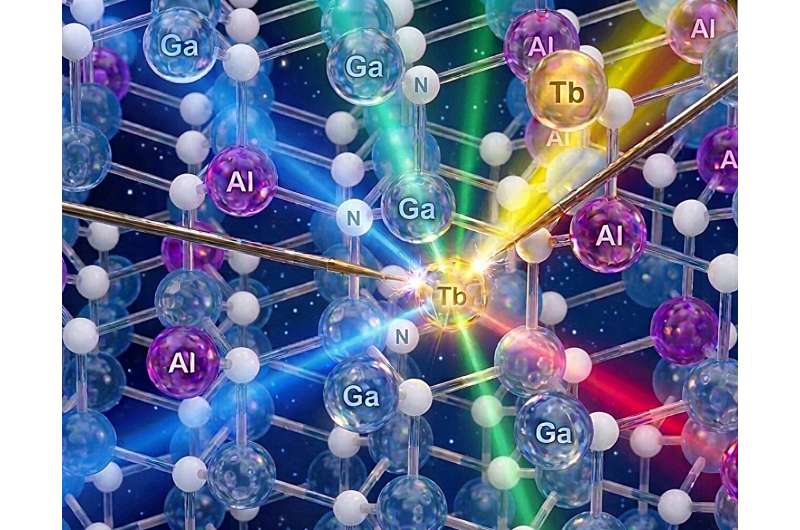
Full-color displays normally require separate red, green and blue light emitters. A team from the University of Osaka and Ritsumeikan University has demonstrated another approach: a single light-emitting layer that produces several colors when electrically powered at room temperature. The study was published in Applied Physics Letters.
Micro-LED displays promise high brightness, energy efficiency and resolution. However, conventional green and red nitride LEDs can show changes in color as the current increases. Producing several colors also generally requires multiple light-emitting layers or separately manufactured chips, making it difficult to place many pixels into a very small area.
The team used a manufacturing method already widely employed for nitride LEDs to create aluminum gallium nitride LEDs containing terbium ions.
These ions produced blue, green, yellow and red light from the same light-emitting area. When the researchers changed the current, no shift in the emission peaks could be detected within the measuring instrument's resolution of 0.6 nanometers.
Increasing the amount of aluminum helped energy move more efficiently from the semiconductor material to the terbium ions. As a result, the external quantum efficiency increased by up to 10.3 times compared with the device containing the lowest amount of aluminum tested in the study.
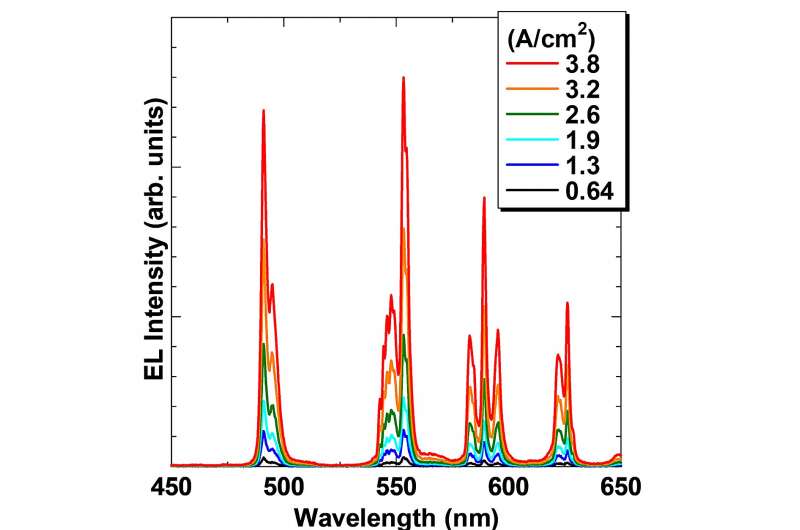
The researchers also improved the crystal quality and device performance by growing the LEDs on an aluminum nitride base layer, which provided a better match with the light-emitting material and reduced defects. Using color filters, the team was able to obtain red, green and blue light separately from the same light-emitting area.
This single-layer approach could make it easier to integrate several colors into one micro-LED device and reduce the need to assemble separately manufactured red, green and blue chips.
The technology is still at an early stage, and further improvements in efficiency and control of the brightness of each color will be needed. In the future, it could contribute to compact, high-resolution displays for smart glasses, wearable devices and other applications, as well as new white light sources.
"We demonstrated multiple colors from one light-emitting layer, together with exceptional stability as the current changed," said senior author Shuhei Ichikawa. "Our next goal is to improve the efficiency and control the intensity of each color."
TrendForce 2026 Micro LED Display and Non-Display Application Market Analysis
Release: 30 September 2026
Format: PDF
Language: Traditional Chinese / English
|
If you would like to know more details , please contact:
|


