At AWE (Augmented World Expo) 2026, Qualcomm's Director of Product Marketing, Matthew DeHamer, officially unveiled the Snapdragon Reality Elite, a new flagship computing platform designed for next-generation immersive XR (Augmented Reality and Virtual Reality) devices.
Qualcomm's new flagship computing platform, Snapdragon Reality Elite, designed for next-generation immersive XR devices.
Compared to the previous naming conventions such as XR1 and XR2, this flagship product is now called "Reality Elite." Matthew DeHamer clarified in his presentation that the "Elite" designation does not mean it uses the Oryon CPU architecture like PCs and mobile devices, but rather symbolizes that this platform is positioned as the top-of-the-line flagship within the Qualcomm XR product line.
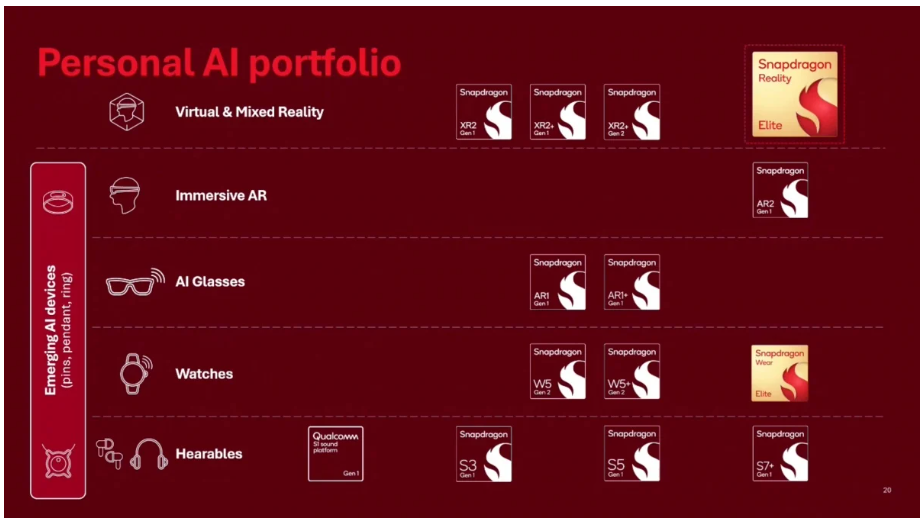
Reality Elite is positioned for flagship XR device applications, while more immersive AR devices will continue to receive updates to their related computing platform solutions.
Significant leap in computing power: Aiming to rival the NPU performance of Apple Vision Pro
In terms of hardware specifications, the Snapdragon Reality Elite is built for the ultimate visual experience and edge-generated AI. In terms of visual output, the platform supports up to 4.4K resolution per eye and a screen refresh rate of 90FPS, and also supports advanced rendering technologies such as ray tracing and mesh shading in hardware.
Compared to the previous generation Snapdragon XR2+ Gen 2 computing platform, Reality Elite offers a 30% improvement in CPU performance (or a 45% reduction in power consumption at the same performance) and a 60% improvement in GPU performance (or a 64% reduction in power consumption at the same performance).
But what's truly remarkable is the performance of the Hexagon NPU in the Reality Elite. In this launch, Qualcomm made no secret of directly comparing the Reality Elite to the Apple Vision Pro: compared to the Vision Pro's 38 TOPS NPU computing power, the Snapdragon Reality Elite achieves an astonishing 48 TOPS.
This gives the new platform a significant advantage when executing large-scale language and visual generative models at the edge. According to official data, Reality Elite can smoothly run a 30 billion-parameter Llama model on the device, generating 45 tokens per second; when performing Stable Diffusion to generate a 512×512 resolution image, it only takes about 1.7 seconds.
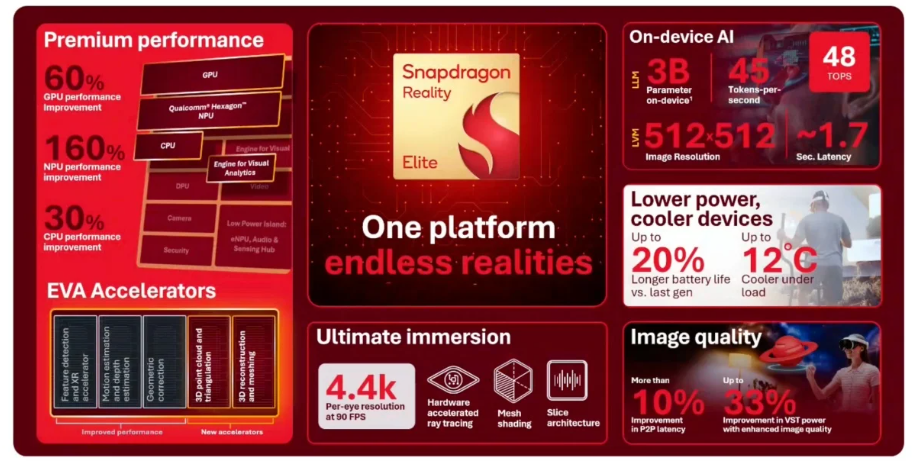
Specific features of Snapdragon Reality Elite
Importing a dedicated EVA engine resolves VST perspective delay and overheating issues.
The biggest challenge for mixed reality (MR) devices currently lies in the latency of video-see-through (VST) and the heat generated by high-load computing. To address this, Qualcomm has introduced a dedicated "Engine for Visual Analytics" (EVA) for the first time in Reality Elite.
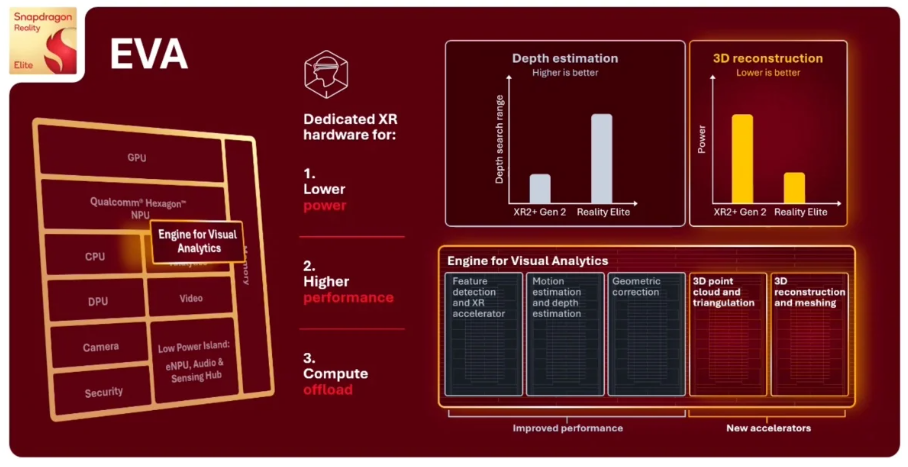
Qualcomm has introduced a standalone "Engine for Visual Analytics" (EVA) for the first time in Reality Elite.
This dedicated hardware acceleration block separates the tasks of depth estimation, geometric correction, 3D point cloud and mesh reconstruction that previously had to be handled by the CPU or GPU. This not only improves the overall VST perspective P2P (photon to photon) latency by more than 10%, but also significantly reduces power consumption in VST mode by up to 33%.
In terms of heat dissipation and battery life, thanks to the optimization of the overall architecture, devices equipped with Reality Elite can not only improve battery life by up to 20%, but also reduce chip temperature by up to 12 degrees Celsius under high load operation. This is a crucial upgrade for XR devices that need to be worn close to the user's face.
Embracing the "Decoupled" Architecture and the START Ecosystem Plan
To reduce the weight of the headset, Matthew DeHamer emphasized in his presentation Reality Elite's deep optimization of "disaggregated XR devices".
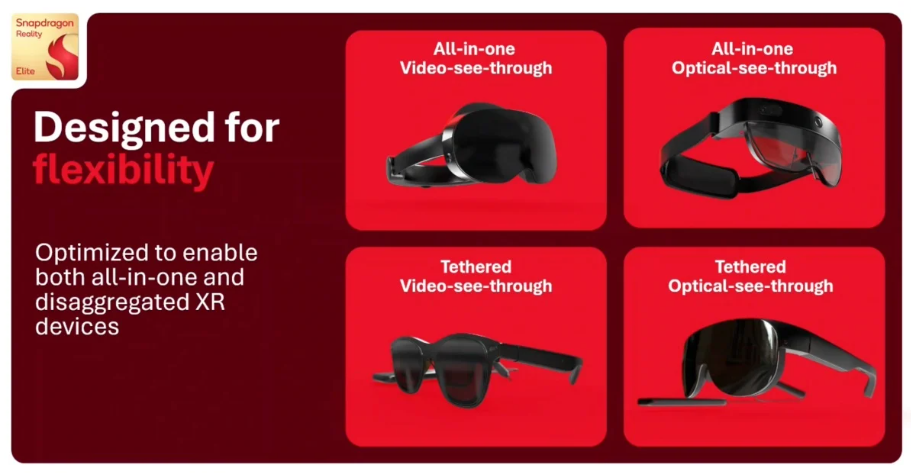
Reality Elite's deep optimization of "disaggregated XR devices"
Future flagship XR devices will no longer be limited to cramming all the batteries and computing components into the glasses themselves (All-in-one). Instead, the core processor and battery can be moved to an external "computing module" or directly driven by a smartphone and connected to the thin glasses via a dedicated data cable.
The event also served as a preview of XREAL's upcoming launch.Project AuraIn fact, it uses a discrete computing module solution with Snapdragon Reality Elite as the core.
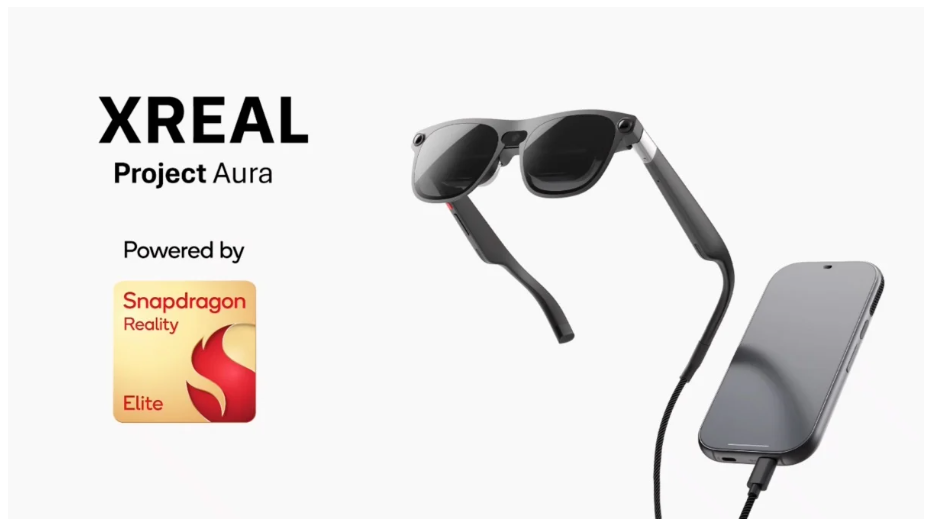
XREAL's upcoming Project Aura actually uses a discrete computing module solution with Snapdragon Reality Elite as its core.
In addition, to accelerate the development speed of OEMs, Qualcomm announced the "Snapdragon START Program" (Scalable Turnkey AI-Ready Toolkit). This solution integrates chip modules (SiP modules with package sizes as small as 12x52mm), software, and cloud AI architecture, allowing manufacturers to quickly bring AI glasses or wearable devices to market through "white-label" or customized methods.

Qualcomm announces the launch of the "Snapdragon START Program" (Scalable Turnkey AI-Ready Toolkit)
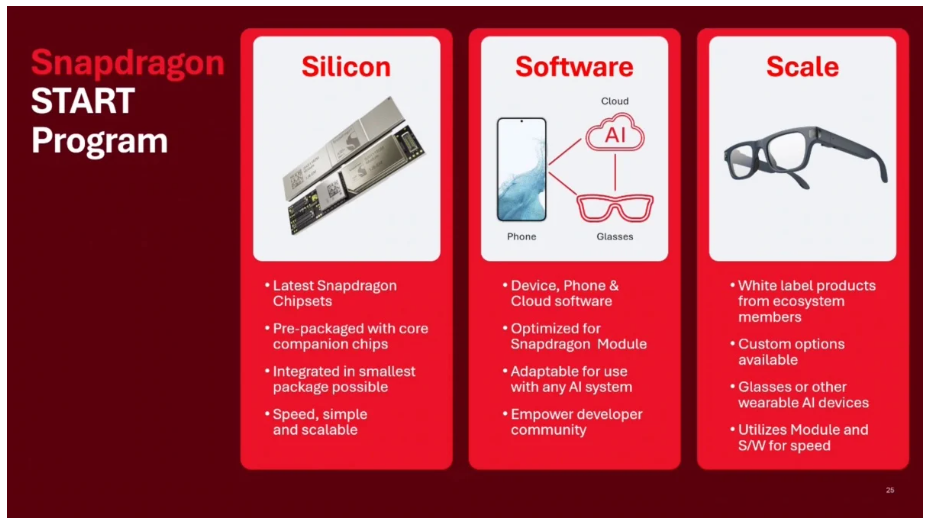
The START plan aims to accelerate the market scaling of AI glasses products through modularized substrates, software, and reference designs.
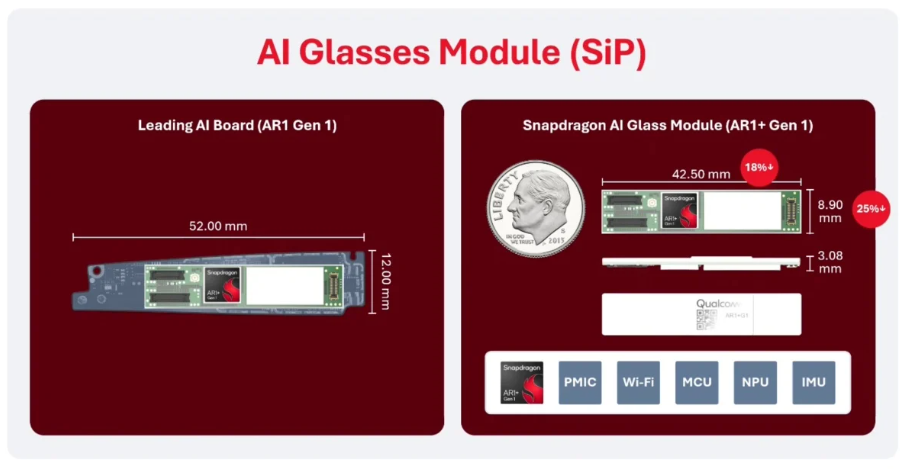
Through modular substrate design, more wearable devices such as AI glasses can be designed into actual products more quickly.
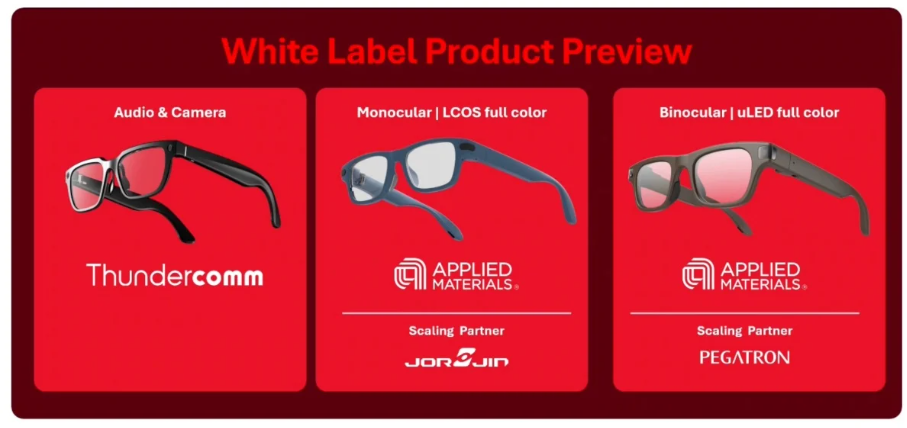
Leveraging past strategies in the white-label mobile phone market to accelerate the expansion of the AI glasses product market.
Meanwhile, Qualcomm also expanded its ecosystem by releasing a second-generation Smart Ring Controller reference design based on the Snapdragon S7+ Gen 1. This ring combines Bluetooth Low Energy and low-power Wi-Fi, and uses AI to recognize the user's micro-gestures (such as swipes and pinches) as a low-power input interface for XR glasses, while also providing health monitoring functions.
In further elaboration, Qualcomm stated that it currently primarily views the smart ring as an "accessory" for interactive operation of wearable devices, and has no plans to develop it as a separate product category for reference design, but is closely monitoring this market trend.
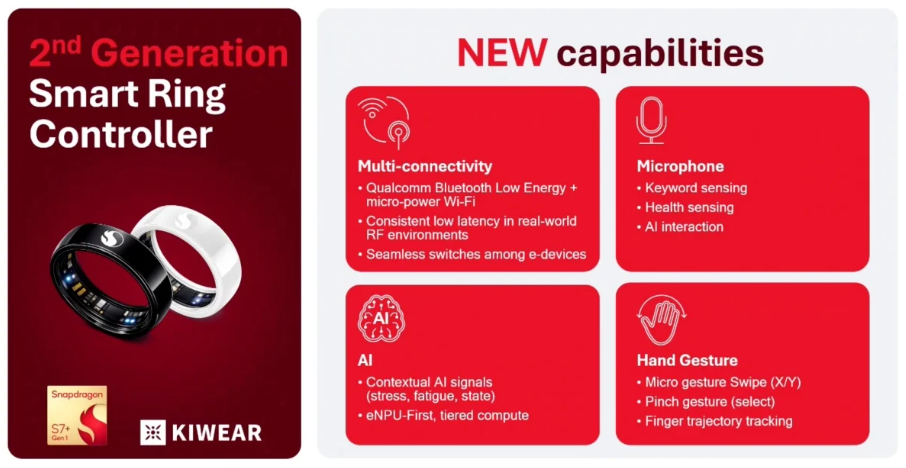
Qualcomm currently primarily views the smart ring as an "accessory" for interactive operation of wearable devices, but has no plans to develop it as a separate product category as a reference design.
Post-meeting Q&A and the author's analysis
Following Matthew DeHamer's presentation, and in response to related questions, the following is a summary and analysis of several key industry trends:
Computing power comparison and architectural differences with Vision Pro
Regarding the comparison of NPU computing power in the presentation, Qualcomm's strategy of highly integrating EVA (Visual Analytics Engine), GPU, and Hexagon NPU into a single SoC is drastically different from Apple's approach of combining the M2 and R1 chips. This avoids the power consumption and latency caused by frequent data transfer between different chips. This move establishes Qualcomm's core position in the Android XR camp, especially with the support of a high-performance NPU, edge AI will become the core strength for major brands to promote "virtual assistants" in the future.
Why is there such a strong push for "disaggregated" design right now?
Qualcomm has clearly stated that all-in-one devices face significant physical limitations in terms of weight and heat dissipation when pursuing 4.4K high-definition display and powerful AI computing per eye. The Reality Elite-supported split architecture, which separates the computing unit from the display glasses, represents the best solution for balancing "ultimate performance" and "wearing comfort" over the next two to three years.
Future platform segmentation strategy for XR and AR product lines: Will it move towards a single platform?
During the Q&A session, when asked whether Qualcomm would merge its XR and AR product lines in the future and use the Reality Elite single computing platform to handle all subsequent designs, Matthew DeHamer gave a clear negative response. He stated that the launch of Snapdragon Reality Elite was not intended to integrate all AI glasses and immersive devices into a single solution.
He further explained that Reality Elite remains positioned for higher-end immersive devices, namely those requiring high-resolution visual presentation and powerful computing capabilities such as 6DoF (six degrees of freedom) tracking. In contrast, when transitioning to the lightweight "AI Glass" category, since these products typically do not require 6DoF or complex hand tracking functions, Qualcomm will maintain it as a separate category and provide dedicated solutions and product portfolios.
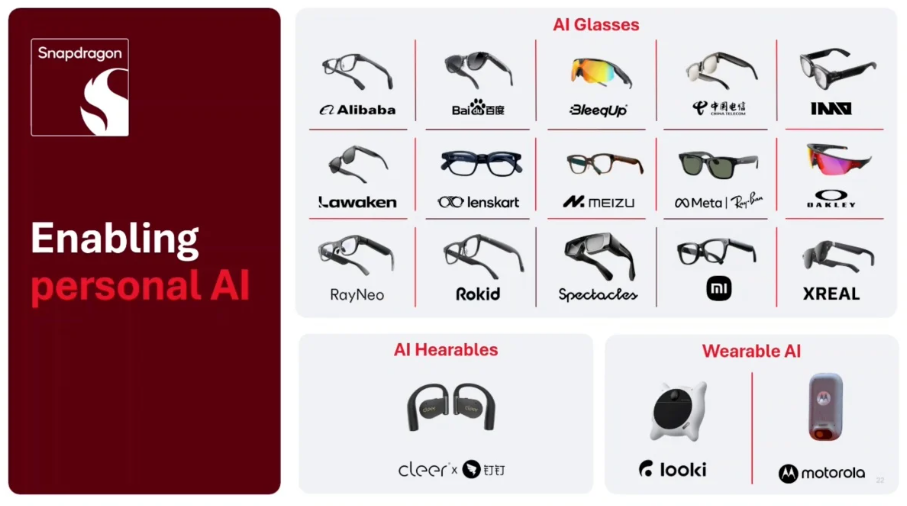
Qualcomm will also focus on the AI glasses market in the future, while continuing to invest in the development of AI headphones and wearable devices.
Market Landscape of Smart Rings and Wearable Devices: How to View the Rise of Competitors like Ora?
In response to Qualcomm's announcement of its second-generation smart ring controller, some media outlets inquired about Qualcomm's development strategy for smart wearables and rings, given that products like the Ora smart ring on the market are increasingly incorporating health management features.
Matthew DeHamer pointed out that existing smart rings on the market, in their early stages of development, mainly focused on basic health status, exercise, and sleep monitoring. However, Qualcomm's approach and strategy for smart rings are completely different. He emphasized that if smart rings are to drive further adoption and awareness in the market, they must interact with a larger "device ecosystem," and Qualcomm sees "XR/AR glasses" as the most natural and core extension accessory for smart rings.
According to Matthew DeHamer, the development of smart wearable devices must be "multi-track and complementary." Qualcomm has already made chip technology deployments for different parts of its smart wearable product line, such as earables, watches, and body-worn AI components (such as AI pins and pendants).
Although this second-generation ring chip originates from a wearable hearing platform (S7+ Gen 1), it provides multi-device connectivity, touch control, AI signal sensing, and micro-gesture operation. Its ultimate goal is to make the ring a universal and seamless controller that connects smart glasses, mobile phones, or in-vehicle systems.
TrendForce 2025 Near-Eye Display Market Trend and Technology Analysis
Publication Date : 29 August 2025
Language : Traditional Chinese / English
Format : PDF
Page Number: 168
|
If you would like to know more details , please contact:
|


