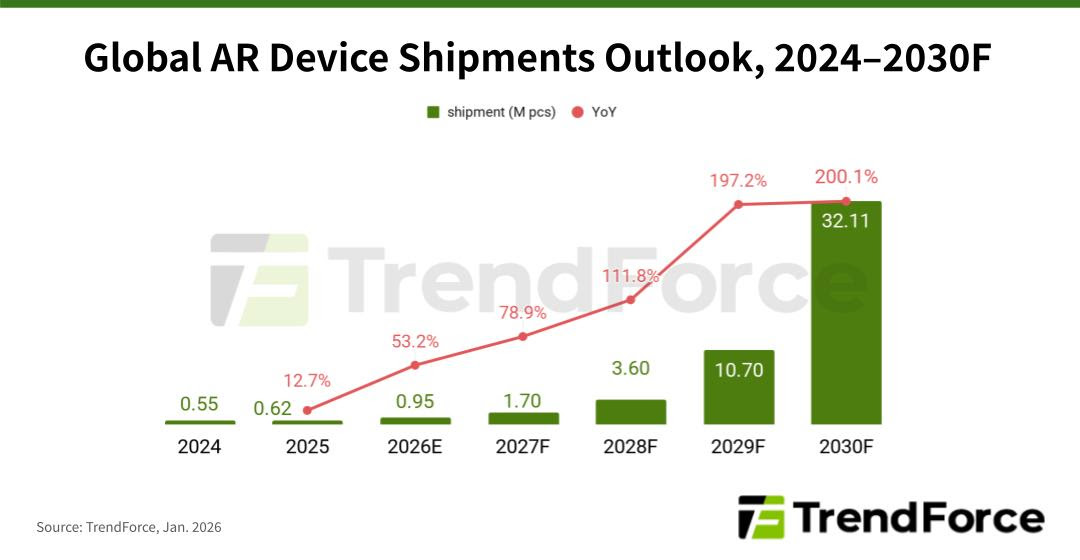
TrendForce’s recent research on the near-eye display industry indicates that the growing convergence of AI and wearable devices has resulted in stronger-than-anticipated market response for Meta Ray-Ban Display Glasses. In the last six months, Meta has significantly increased orders for several key components. Driven by this strong backing from leading brands, TrendForce forecasts global AR glasses shipments will reach 950,000 units by 2026, a 53% YoY increase.
TrendForce’s supply chain survey shows that Meta initially took a cautious approach to AR glasses demand, considering past VR sales and limitations in optical component supply. For instance, Lumus’ geometric waveguide—manufactured through a complex and precise process—initially received around 80,000 units in orders, indicating a tentative market test.
However, Meta quickly revised its pull-in rate within six months of launching the product, with recent orders rising by 87.5% to 150,000 units. Orders for other components, such as OmniVision’s liquid crystal on silicon (LCoS), GoerOptics’ optical engine assemblies, and SCHOTT’s waveguide-related optical parts, have also grown steadily.
Upstream display and assembly partners are working concurrently to optimize production lines and boost yields, aiming to handle the growing order volume. This effort aligns with Meta’s phased goal of reaching a total of 500,000 units shipped within the next two years.
TrendForce observes that rapid sell-through at the channel level indicates strong consumer interest in AI smart glasses with integrated displays. It also mentions that Meta’s changes to its wearable-device strategy have somewhat eased market worries caused by the earlier slow sales of VR devices.
In the near future, Meta’s achievements are likely to boost hardware upgrades among competing brands and ecosystem collaborators. It will also expand AI applications and enhance integration within the AR-glasses software ecosystem.
As Meta prepares to launch its next-generation product, major companies such as Samsung and Google are also preparing to release their own AR glasses. The industry’s growth will depend heavily on whether existing supply chains can rapidly increase capacity and improve yields in key areas that are crucial to smooth expansion, such as optics, displays, and assembly.
Eventually, as the novelty effect diminishes, consumers will prioritize practical value and high-quality AI experiences. Brands that effectively balance comfort, affordable pricing, and a strong content ecosystem will be best positioned to meet growing market demands and advance into the next growth stage. According to TrendForce, with increased participation from major vendors fueling expansion, global AR glasses shipments are expected to hit 32.11 million units by 2030.
TrendForce 2025 Near-Eye Display Market Trend and Technology Analysis
Publication Date : 29 August 2025
Language : Traditional Chinese / English
Format : PDF
Page Number: 168
|
If you would like to know more details , please contact:
|


