As large multimodal models (LMM) approach maturity, AR glasses have evolved from simple display devices to sensory interfaces for AI. This brings on-screen interactions into physical reality, transforms search tools into personal life assistants, and bridges the gap in real-world AI deployment. Companies are shifting their focus from competing on hardware specifications to securing positions within ecosystem frameworks. Amid this shift, Chinese brands are extending their influence while rapidly staking their claims.
This transformation has not only prompted software giants such as Baidu and Alibaba to view AR glasses as a new vehicle for cloud computing and data services, but also driven consumer electronic brands like Xiaomi and Lenovo to expand their ecosystems by integrating AR glasses into their hardware portfolios. Brands are also accumulating users’ first-person visual data and AI preferences to build formidable competitive moats, converting what was once a mere hardware sales business into a critical gateway to capture sustained user attention.
The rapid entry of Chinese AI model developers and traditional hardware manufacturers into the AR market has been facilitated by the supply chain groundwork laid by pioneering AR startups. With core technologies now reaching maturity and barriers to hardware development significantly decreasing, companies can fast-track the rollout of their own branded products. Meanwhile, the heated rivalry between hardware manufacturers and model developers further accelerates product iteration and drives prices downward.
However, the main traction for the AR glasses business extends beyond the potential of AI applications and its more accessible supply chain. Another critical appeal lies in its intrinsically high sunk costs for users to switch to a different AR glasses provider. These devices usually require customized visual correction lenses. Once users are equipped with their prescription lenses and adjust to their focal type, brand hopping becomes a costly endeavor. Likewise, dependence on a specific spatial control system or brand ecosystem can also increase the difficulties in adopting a different brand’s offerings.
Confronting the asymmetric competitive pressure from internet heavyweights, AR hardware startups, such as XREAL and Rokid, are undergoing a strategic transformation. They are shifting from being pure manufacturers to solution providers or ecosystem operators. On one hand, they are entering the AI-integrated AR glasses space and exiting the specifications arms race, while developing spatial control systems or deepening strategic partnerships with AI companies. On the other hand, they continue to gain more assembly know-how in critical technologies, such as thermal management of optical engines with high luminance, ultra-lightweight form factor designs, and complex optical calibrations. Such physical-layer engineering and technological expertise serves as a deterrent for pure software players to enter the segment in the short term.
From a broader perspective, current pre-competitive dynamics provide untapped potential for Chinese brands. They can leverage supply chain advantages to establish scaled forms of protection before big names including Meta, Google, and Apple initiate mass-market penetration in China. Besides, these brands benefit from an inherent edge in integrating local ecosystems such as WeChat, Douyin, and Alipay. By building a comprehensive ecosystem of AI applications and doubling down localized services, they can cultivate strong habitual engagement and ecosystem stickiness, ultimately creating prohibitively high barriers to user acquisition for foreign competitors. TrendForce research reveals that while Chinese manufacturers dominated the AR glasses market with a 94.5% shipment share in 2024, that figure has slipped to 88.3% in 2025 as Meta and other global players ramp up international expansion. This trend reflects rising global interest in the AR glasses market, as well as an emerging competitive landscape reshaped by the more mature portfolios of international tech giants. TrendForce forecasts that Chinese brands' market share will contract to 50.2% by 2030.
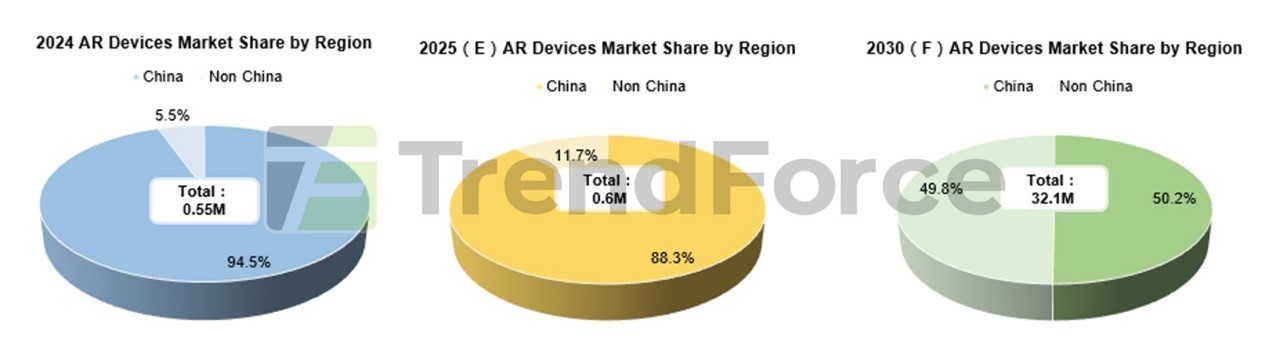
AR glasses market share of Chinese and non-Chinese brands.
Author: Emerson/ TrendForce
TrendForce 2025 Near-Eye Display Market Trend and Technology Analysis
Publication Date : 29 August 2025
Language : Traditional Chinese / English
Format : PDF
Page Number: 168
|
If you would like to know more details , please contact:
|


