How to Choose Dimming Curves, Linear or Logarithmic?

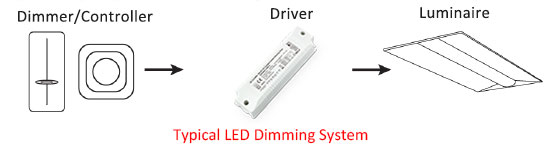
Often, the LED lighting system consists of a (wall) dimmer or controller, a driver and a luminaire. To dim the light, you move the slider or turn the wheel and the dimmer sends a signal to the driver. The driver translates that signal to an electrical current that powers the LED.

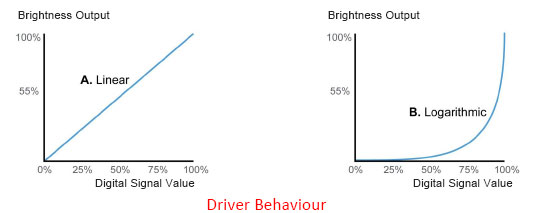
In linear dimming curves of LED drivers, the brightness output is linear in relation to the digital signal value which is translated by the driver. For instance, if the digital signal value is at 25%, the brightness output is at 25%- see A.

However, in logarithmic dimming curves, the digital signal value changes slower at deeper dimming levels and faster at the brighter end-see figure B.

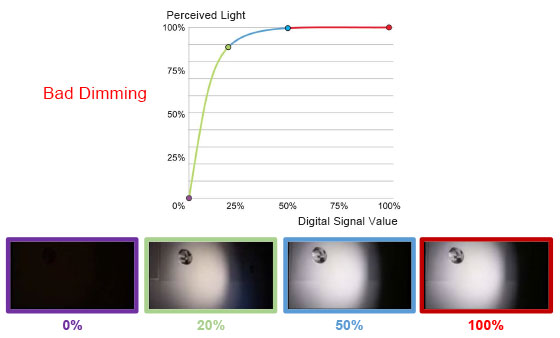
If the system is not configured properly, the dimming performance can be unsatisfactory. In figure 4, the difference in light output is quite large. And at the bright end on the right, the difference is barely noticeable. The whole dimming effect is not good.

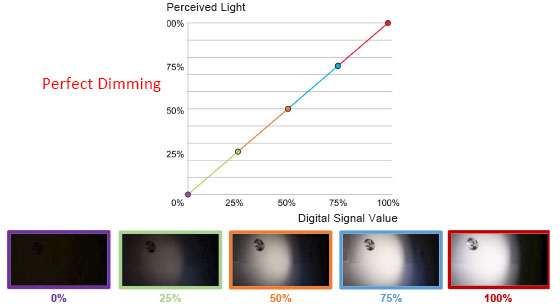
The light level changes evenly with the dimmer position. The result of a much better implementation of a lighting system is shown in figure 5.

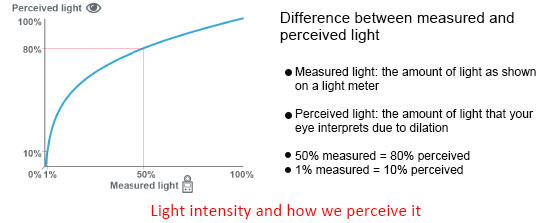
To achieve perfect dimming performance, the brightness of the LED must be matched to the way our eyes behave. With a linear dimmer, a logarithmic dimming curve should be used in the driver.


(Image & Video Source: Euchips)

Disclaimers of Warranties
1. The website does not warrant the following:
1.1 The services from the website meets your requirement;
1.2 The accuracy, completeness, or timeliness of the service;
1.3 The accuracy, reliability of conclusions drawn from using the service;
1.4 The accuracy, completeness, or timeliness, or security of any information that you download from the website
2. The services provided by the website is intended for your reference only. The website shall be not be responsible for investment decisions, damages, or other losses resulting from use of the website or the information contained therein<
Proprietary Rights
You may not reproduce, modify, create derivative works from, display, perform, publish, distribute, disseminate, broadcast or circulate to any third party, any materials contained on the services without the express prior written consent of the website or its legal owner.

Veeco Instruments Inc. today announced that a global leader in optical communications laser manufacturing placed orders for multiple Lumina® Metal Organic Chemical Vapor Deposition (MOCVD) systems and multiple Spector® Ion Beam Sputter... READ MORE

Clive Davis, the iconic, award-winning record producer known for launching the careers of Whitney Houston, Bruce Springsteen, Janis Joplin, and more, chose Samsung to help transform his Westchester, New York home theater into a world-class cin... READ MORE