New LED Lamp Released for Quake-hit Areas in Japan

100 units of a portable lamp, which uses dye-sensitized solar cells (DSSCs), LEDs and nickel-metal-hydride rechargeable batteries, made by A Japanese research group and a manufacturing company.
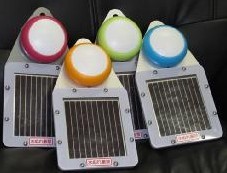
The group was led by Hiroshi Segawa, professor at the Research Center for Advanced Science and Technology (RCAST) of the University of Tokyo. It distributed the lamps to two areas affected by the Tohoku Earthquake.

The portable lamp was made by combining (1) a palm-sized DSSC panel developed by the manufacturing company, which has been engaged in research with the research group, (2) a commercially-available LED lamp that can be turned on by pressing the light-emitting part by hand and (3) rechargeable batteries (two AA nickel-metal-hydride batteries).

It is not necessary to replace batteries. By exposing the portable lamp to sunlight during daytime hours, the batteries can be charged with electricity generated by the DSSCs. When the batteries are fully charged, the LED lamp can be continuously lit for about 20 hours.

Disclaimers of Warranties
1. The website does not warrant the following:
1.1 The services from the website meets your requirement;
1.2 The accuracy, completeness, or timeliness of the service;
1.3 The accuracy, reliability of conclusions drawn from using the service;
1.4 The accuracy, completeness, or timeliness, or security of any information that you download from the website
2. The services provided by the website is intended for your reference only. The website shall be not be responsible for investment decisions, damages, or other losses resulting from use of the website or the information contained therein<
Proprietary Rights
You may not reproduce, modify, create derivative works from, display, perform, publish, distribute, disseminate, broadcast or circulate to any third party, any materials contained on the services without the express prior written consent of the website or its legal owner.

microLEDs: from headlamps to the data center When we think about the evolution of AI technology, developments in machine learning and large language models come readily to mind, as do the latest graphics processing units (GPUs), high-bandwidth... READ MORE

The question of what makes a building "smart" has been debated in the industry for years. ams OSRAM provided a clear answer at Light + Building 2026: it is light — not as illumination, but as a sensory nervous system. It percei... READ MORE