(From Left) Professor Keon Jae Lee, Professor Tae-Hyuk Kwon, Ph.D candidate Min Seo Kim, Dr. Jae Hee Lee, Dr. Chae Gyu Lee
Conventional pancreatic cancer treatments face a critical hurdle due to the dense tumor microenvironment (TME). This biological barrier surrounds the tumor, severely limiting the infiltration of chemotherapy agents and immune cells. While photodynamic therapy (PDT) offers a promising alternative, existing external light sources, such as lasers, fail to penetrate deep tissues effectively and pose risks of thermal damage and inflammation to healthy organs
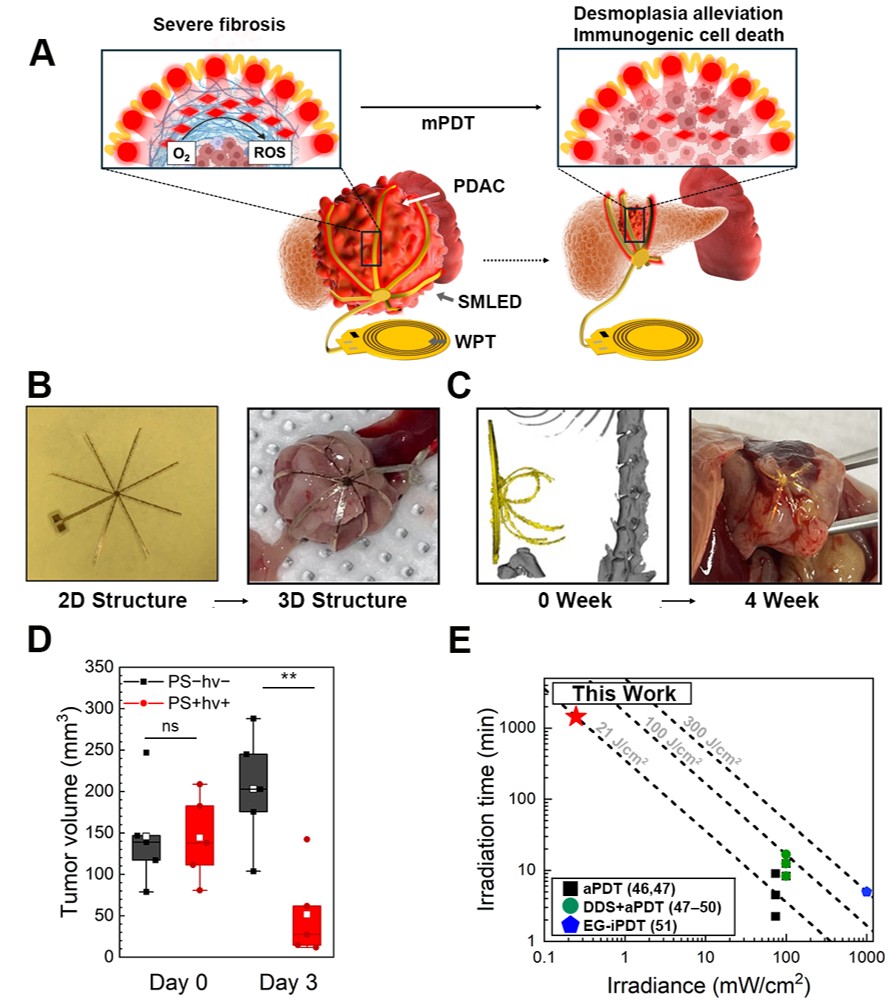
To address these challenges, Professor Keon Jae Lee’s team at KAIST, in collaboration with Professor Tae-Hyuk Kwon at UNIST, developed an implantable, shape-morphing 3D micro-LED device capable of effectively delivering light to deep tissues. The key technology lies in the device’s flexible, octopus-like architecture, which allows it to wrap around the entire pancreatic tumor. This mechanical compliance ensures uniform light delivery to the tumor despite the tumor’s physiological expansion or contraction, enabling continuous, low intensity photostimulation that precisely targets cancer cells while preserving normal tissue.
In in-vivo experiments involving mouse models, the device demonstrated remarkable therapeutic efficacy. Within just three days, tumor fibrous tissue was reduced by 64%, and the pancreatic tissue successfully reverted to normal tissue, overcoming the limitations of conventional PDT.
Prof. Keon Jae Lee said, "This research presents a new therapeutic paradigm by directly disrupting the tumor microenvironment, the primary obstacle in pancreatic cancer treatment." He added, "We aim to expand this technology into a smart platform integrated with artificial intelligence (AI) for real-time tumor monitoring and personalized treatment. We are currently seeking partners to advance clinical trials and commercialization for human application."
Overall concept of 3D Shape-morphing micro-LEDs (SMLEDs). The 3D long-term, low-intensity photodynamic therapy (PDT) system attaches to the pancreatic surface, ensuring stable and continuous light delivery. Initially maintaining a 2D structure, the system morphs into a 3D structure upon implantation to conform to the shape of the pancreas. In in vivo experiments, the device maintained stable adhesion without detachment for four weeks and reduced the pancreatic tumor size by 64%
Professor Tae-Hyuk Kwon commented, "While phototherapy is effective for selective cancer treatment, conventional technologies have been limited by the challenges of delivering light to deep tissues and developing suitable photosensitizers." He added, "Building on this breakthrough, we aim to expand effective immune-based therapeutic strategies for targeting intractable cancers."
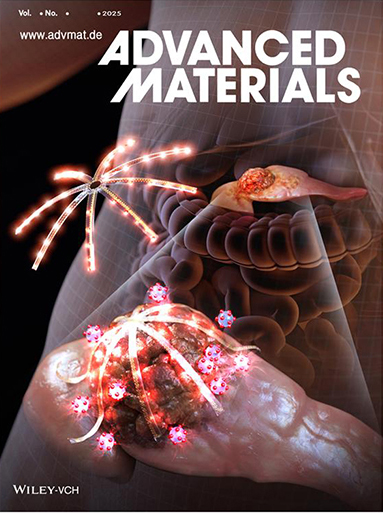
Cover Image. The 3D long-term, low-intensity photodynamic therapy (PDT) system, developed by Professor Keon Jae Lee's team at the Department of Materials Science and Engineering at KAIST, was featured as the cover article of the international journal Advanced Materials
The result, titled "Deeply Implantable, Shape-Morphing, 3D MicroLEDs for Pancreatic Cancer Therapy," was featured as the cover article in Advanced Materials (Volume 37) on December 10, 2025.
Disclaimers of Warranties
1. The website does not warrant the following:
1.1 The services from the website meets your requirement;
1.2 The accuracy, completeness, or timeliness of the service;
1.3 The accuracy, reliability of conclusions drawn from using the service;
1.4 The accuracy, completeness, or timeliness, or security of any information that you download from the website
2. The services provided by the website is intended for your reference only. The website shall be not be responsible for investment decisions, damages, or other losses resulting from use of the website or the information contained therein<
Proprietary Rights
You may not reproduce, modify, create derivative works from, display, perform, publish, distribute, disseminate, broadcast or circulate to any third party, any materials contained on the services without the express prior written consent of the website or its legal owner.
France-based car maker Peugeot unveiled a new concept car, the Peugeot RCZ Vision, building on the company's 2009-2015 RCZ coupe - with a host of new technologies.
The RCZ Vision, build on Stellantis' STLA One architecture, is an ele... READ
MORE
The transition from halogen to LED technology is becoming even easier: ams OSRAM expands its portfolio of ECE-approved LED retrofit lamps with the NIGHT BREAKER LED SPEED ECE H8, HB4 and H16. The new lamps expand the options for retrofitting t... READ
MORE