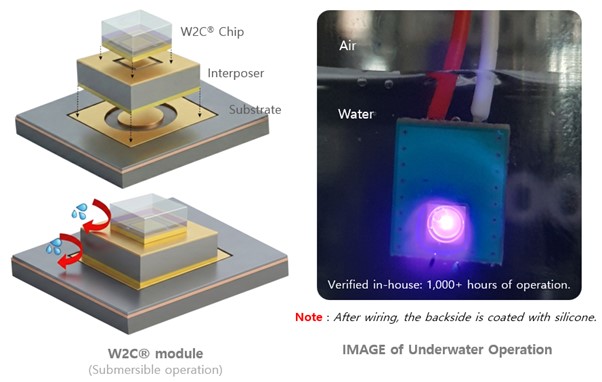
Exposing semiconductor chip to aqueous environments typically induces rapid galvanic corrosion, electrolysis, and catastrophic short-circuiting. Therefore, special protective solutions like bulky hermetic seals, quartz windows, or robust encapsulation, while necessary, often introduce significant thermal resistance and optical losses.
According to Elphoton, the W2C® technology circumvents these limitations by fundamentally addressing the failure mechanisms at the electrode level. Through a proprietary electrode design and passivation strategy, the company has solved the physical degradation processes associated with underwater operation. Chips, interposers, and substrates feature a closed-loop electrode architecture and are integrated through a perfect hermetic seal. In this configuration, the interposer serves as a vital structural bridge, facilitating the interconnection between the chip and the substrate.
The UVC-LED market is currently experiencing accelerated growth, driven by tightening environmental regulations across Europe and the U.S. that mandate the phase-out of traditional, toxic mercury-vapor lamps. However, deploying UVC-LEDs in their primary application areas—such as water purification systems, high-humidity environments, and zones prone to condensation—has remained a persistent reliability challenge for the industry. Moisture ingress remains a primary failure mode for conventional LED packages.
By implementing the W2C® architecture, Elphoton’s new UVC-LED achieves several critical engineering advantages like Elimination of Hermetic Bottlenecks, Enhanced Reliability, and ultra-compact modules
" The direct-to-water capability offers a compelling path to lower Bill of Materials (BOM) costs while simultaneously improving system-level reliability. W2C® is an innovative soution applicable not just to UVC-LEDs, but to any semiconductor chip required to operate in extreme environments," stated Elphoton's CEO. The company plans to expand this robust packaging protocol into emerging sectors like Physical AI operated in harsh, wet, or chemically demanding environments.


