As the global horticultural LED market enters a new phase in 2026, characterized by both cost pressure and technological upgrades, system-level energy efficiency and dynamic spectral control are becoming key priorities. As a leading player in LED innovation - Cree LED continues to gain strong recognition from horticultural lighting brands through its dual-track strategy in high-power ceramic LEDs and cost-effective mid-power solutions.
Recently, TrendForce interviewed Morgan Meadows Davis, Product Manager at Cree LED, to share the company’s 2025–2026 market strategy, product technology roadmap, and outlook for the horticultural lighting industry.

Morgan Meadows Davis, Product Manager at Cree LED
Stable Market Performance Driven by Greenhouses and Vertical Farming
Despite a slowdown in overall market growth in 2025, Cree LED has maintained steady performance. Morgan noted that the company added new partners in 2025, including HLG, SANlight, and Heliospectra, while strengthening long-term relationships with customers such as RED Horticulture, LUX Horticultura, and GS Illuminaciones. LED horticultural lighting manufacturers tend to choose proven, reliable partners. Thus, Cree LED’s IP-Free strategy, consistent performance, and long-term reliability have become key advantages for customers seeking design flexibility and durability.
From application perspective, Greenhouse and Vertical farm are the primary growth drivers in 2025, with demand driven by both LED retrofit projects and new installations. Morgan stated that growers continue to raise their performance expectations, beyond demanding Photon Efficacy(PPE) far higher than traditional HPS, they place greater emphasis on spectral application customizability and long-term reliability, including compliance with stringent standards such as DLC Horticulture v4.0 for moisture resistance and power stability.
Providing a Spectral Toolbox for Mixed Spectra and Multi-Channel Control
According to TrendForce observations, spectrum design is shifting from single-band optimization toward system-level solutions combining mixed spectra with dynamic control. The industry is moving beyond traditional red-blue ratios toward full-spectrum architectures with fine-tuned blue and far-red adjustments to improve photosynthetic efficiency and crop yield.
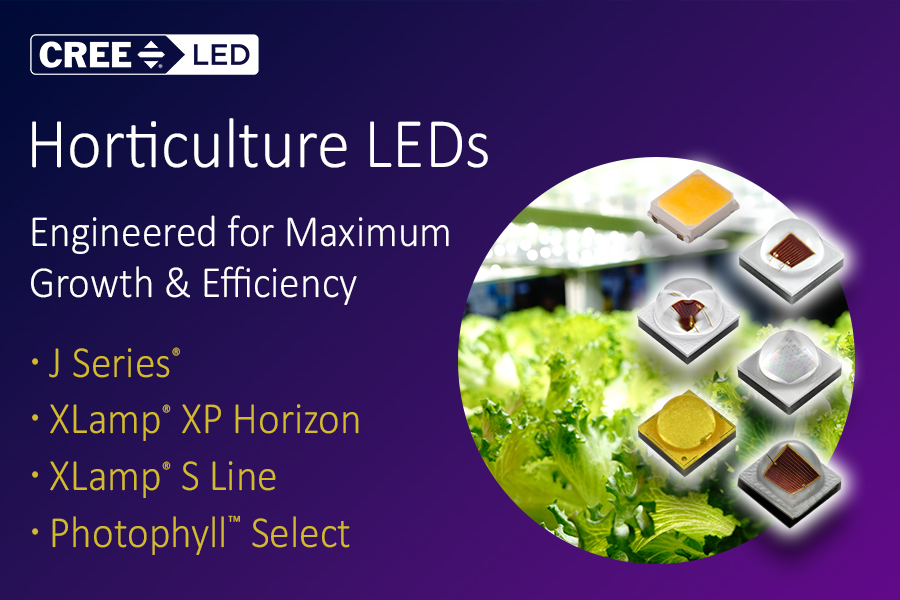
In response, Cree LED offers a broad product portfolio spanning XLamp® high-power LEDs and J Series® mid-power LEDs, forming a comprehensive “spectral toolbox” for tunable, high-efficiency horticultural lighting systems.
Morgan further explained that while full-spectrum LEDs remain essential, growers increasingly require precise control over Red LED, Blue LED, Green LED, and Far-red LED ratios to optimize photosynthesis, morphology, and energy use. To address this, Cree LED introduced Photophyll™ Select LEDs, designed specifically around horticultural performance metrics. These LEDs reduce excessive red output while optimizing blue-green balance to better match plant response curves, improving overall luminaire efficiency.
Cree LED also offers high-efficiency discrete wavelength solutions, including Photo Red and Far Red LEDs, enabling customers to build multi-channel and hybrid spectrum systems. Beyond components, Cree LED provides professional design support to help partners achieve target wavelength ratios, photon output, and system efficiency tailored to specific crops.
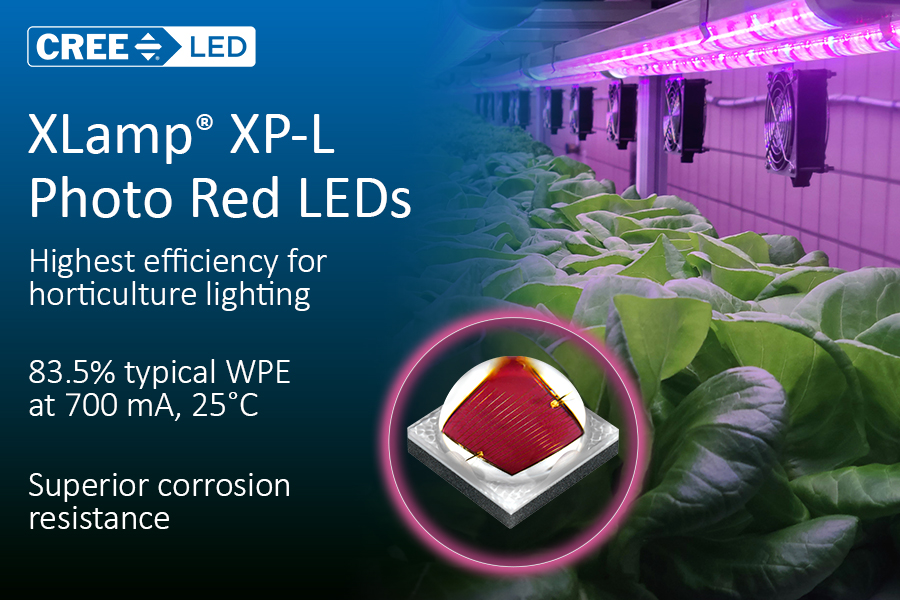
Photon efficacy (PPE, μmol/J) remains the core performance metric in horticultural lighting. Morgan revealed that Cree LED’s 2025 roadmap, they have set a wall-plug efficiency (WPE) targets of approximately 83% for mainstream 660 nm red LEDs, while J Series® white LEDs are designed to reach up to 3 μmol/J under standard operating conditions.
Regarding whether efficiency is approaching physical efficiency limits, Morgan acknowledged that red (660 nm) and far-red (730 nm) LEDs have historically lagged behind blue and phosphor-converted white LEDs. However, recent engineering investments have yielded significant improvements. As efficiency climbs above 85%, the speed of improvement will naturally slow to physical constraints, but opportunities remain particularly through innovations in packaging structure and optical design to achieve impactful improvements.
Parallel High-Power and Mid-Power Strategies to Balance Cost and Reliability
To meet increasing demands for extreme cost-effectiveness, Cree LED continues a strategy of running high power and mid-power lines in parallel. Morgan explained that J Series® mid-power LEDs deliver strong cost-performance and energy efficiency, making them well suited for cost-sensitive applications such as consumer horticulture, supplemental lighting, and high-density vertical farming.
Conversely, XLamp® high-power ceramic LEDs, including XP-L and XP-G3, are designed for demanding environments. These products offer higher PPE, superior thermal performance, sulfur resistance, and long operating life, making them ideal for commercial greenhouses and high-humidity vertical farms where durability and sustained photon output are critical.
Outlook for 2026 and Beyond
Looking ahead to 2026, Cree LED’s horticultural roadmap focuses on continued performance improvements and portfolio expansion. Morgan highlighted the newly launched XP-G3 S Line Far Red LED, which delivers a 21% efficiency improvement over the previous XP-E2 S Line Far Red while maintaining the same footprint for drop-in replacement. The product is available in Horizon70 and Horizon90 beam angles with batwing distribution, improving uniformity and reducing installation height.

Additionally, Photophyll™ Select technology will extend to more product lines and introduce additional green-blue-red (GBR) ratio options- following the 2025 launch of the 3030 GBR 1.0 version, offering growers greater flexibility in spectral recipes.
Critically, all Cree LED products are IP-Free, which lowers intellectual property risks for clients, allowing luminaire manufacturers to innovate with confidence, simplify designs, and accelerate time-to- market. “We help customers understand how higher initial investment can translate into lower operating costs, improved energy efficiency, and better crop performance over time,” said Morgan.
Finally, discussing the biggest challenge for the horticultural lighting market in 2025–2026, Morgan identified the need to strike a balance between cost pressure and growers’ increasing demands for higher efficiency and advanced spectral control. Furthermore, intense price competition and supply chain volatility continue to challenge luminaire manufacturers.
Looking forward, Cree LED anticipates three major industry shifts: First, dynamic spectrum control becoming a standard feature, enabling optimized light recipes for different crops and growth stages. Second, stricter energy efficiency and sustainability regulations drive higher PPE requirements. Third, supplier differentiation based on quality, service, and IP positioning, with growers prioritizing reliable and trusted partners.
To conclude, Cree LED is actively responding through continuous performance improvements, expanding mixed-spectrum options, and providing design support. Its IP-Free strategy and time-tested reliability are expected to continue delivering differentiated value and confidence for partners during this cycle of industry consolidation and technological upgrade.
Author: Christine, TrendForce
If you would like to know more details , please contact:


