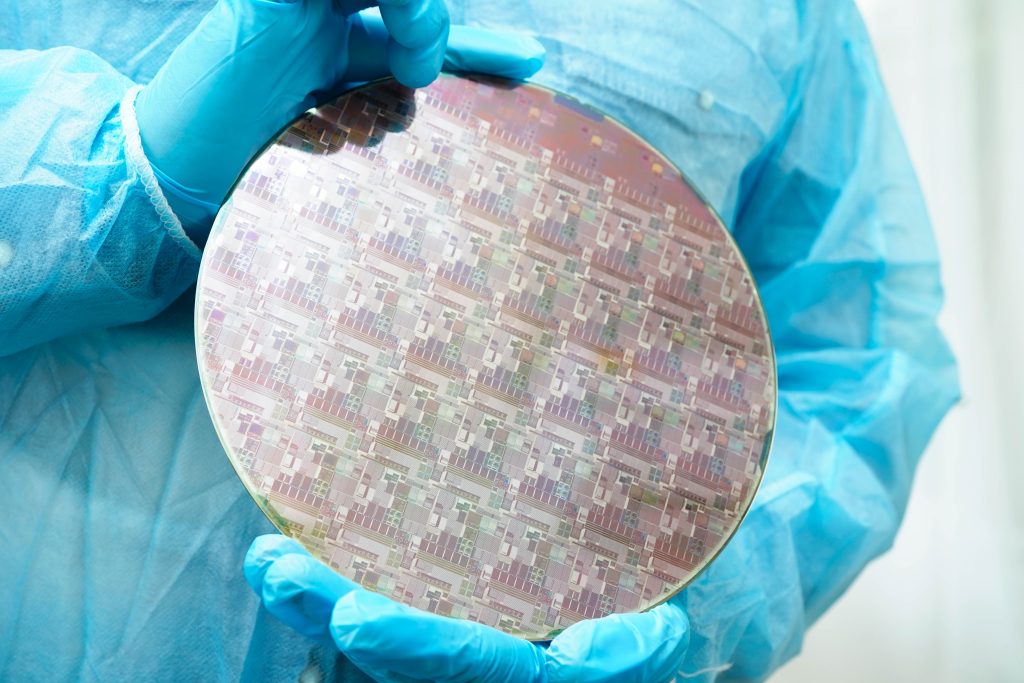
Recently, China-based Ziener Tech has unveiled progress in sapphire substrate thinning, announcing that it has successfully reduced the substrate thickness of its 8-inch GaN-on-sapphire wafers to 50μm.
In practical applications, heat dissipation has long been a key bottleneck limiting GaN device performance. Substrate material plays a critical role in thermal management. Sapphire offers strong insulation, high thermal stability, and relatively good lattice and thermal matching with GaN, enabling simpler epitaxial structures. However, its inherently low thermal conductivity has historically constrained heat dissipation. Thinning the substrate effectively shortens the thermal conduction path, thereby improving overall device thermal performance.
The company’s advancement lies in precise control of the substrate thinning process. According to Ziener, as substrate thickness was gradually reduced from the conventional 200μm to 100μm and ultimately to 50μm, device thermal performance improved significantly. Test data show that at 200μm, the junction-to-case thermal resistance is 1.6°C/W, comparable to silicon-based GaN devices. At 100μm, thermal resistance drops to 1.1°C/W, outperforming silicon-based solutions. At 50μm, it further decreases to 0.8°C/W—about half that of comparable GaN-on-silicon devices.
Benefited from the improved thermal resistance, GaN-on-sapphire devices demonstrate clear thermal advantages over GaN-on-silicon counterparts in real-world applications. Under high-power conditions across various voltages and loads, Ziener’s devices consistently deliver lower temperature rise than competing silicon-based GaN devices, highlighting superior heat dissipation capability.
Further validation in application scenarios also quantifies the impact of substrate thickness on device temperature. In tests conducted on a high-power totem-pole PFC power board, Ziener compared devices with 100μm and 50μm substrates. Results show that at 90 V input, the case temperature of the 50μm device is reduced by 13.6°C compared to the 100μm version; at 264 V input, the reduction reaches 14.5°C. Across multiple voltage and load conditions, GaN-on-sapphire devices consistently deliver lower temperature rise than equivalent GaN-on-silicon devices.
Notably, Ziener also disclosed that it has completed technical development for an ultra-thin 30μm sapphire substrate, indicating further room for thermal performance improvement. For high power density and high-efficiency system applications, substrate thinning offers a viable pathway to overcoming thermal challenges in GaN devices.
Industry analysts note that as the power semiconductor market increasingly demands higher efficiency, reliability, and compact form factors, advancements in substrate technology—an upstream cornerstone—will directly shape downstream competitiveness. GaN-on-sapphire already holds advantages in breakdown voltage and reliability in medium- to high-voltage applications. Continued progress in thermal management is expected to expand its adoption across a broader range of high-power scenarios.
(Photo credit: FREEPIK)


