Stanley Electric Co., Ltd. has significantly improved the emission efficiency of its UV-C LEDs at a wavelength of 265nm—widely recognized as the most effective wavelength for disinfection—and has achieved a wall-plug efficiency (WPE) of 7.5% (158 mW, 350 mA, 6 V), approximately threefold higher than the current level.
This achievement represents not only a major advancement in UV-C LED device performance, but also expands the processing capability of water disinfection applications, further advancing the practical deployment of next-generation, mercury-free disinfection solutions as alternatives to conventional UV lamp systems. In addition, we plan to achieve a WPE of 10% by the end of fiscal year 2026, representing further performance improvements.
Key Development Points
-
Significantly improved emission efficiency through a proprietary structure that enhances light extraction *1 from the AlN (Aluminum nitride) substrate, together with the adoption of a high-reflectivity electrode.
-
Reduction of internal losses through low-defect crystal growth technology on AlN substrates
-
Significant product lifetime enhancement from 10,000 hours to 25,000 hours (L70 *2 )
*1: Technology for efficiently extracting light generated inside an LED die to the outside.
*2: Time during which radiant flux remains at or above 70% of the initial value.
Samples of the UV-C LEDs achieving WPE 7.5% are scheduled to be provided sequentially starting in March 2026.
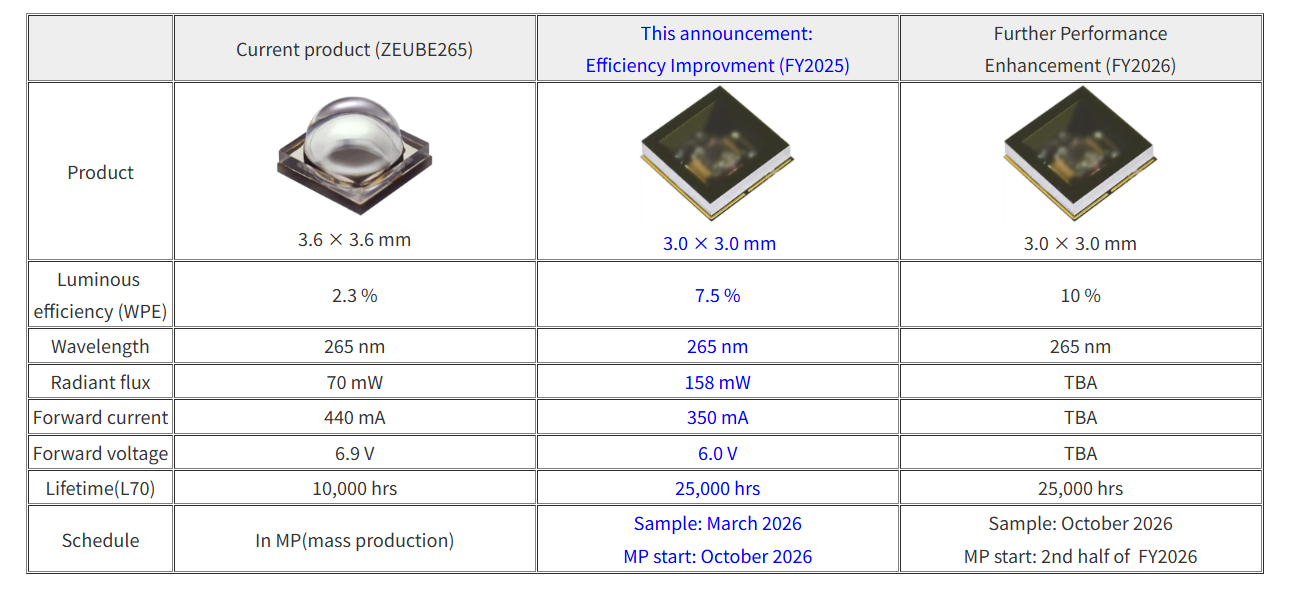
Performance comparison of our UV-C LEDs
Stanley Electric is focused on developing UV-C LEDs of the 265nm wavelength, which is recognized for its high disinfection efficacy. Compared to other wavelengths such as 275nm and 280nm, 265nm achieves higher microbial inactivation efficiency, enabling superior disinfection performance with lower irradiation levels. This represents one of the key features of our UV-C LEDs.
Future Outlook and Contributions to Solving Social Issues
UV-C LEDs are mercury-free light sources, enabling both safe water supply and reduced environmental impact. This improvement in emission efficiency enhances the performance of application products, including water disinfection reactors, facilitating scale expansion from household to industrial applications. Consequently, even in fields where UV lamp systems were previously dominant, the gradual transition to UV-C LEDs is becoming a realistic and compelling option from a practical standpoint, including operational cost considerations. Furthermore, achieving a WPE of 10% will accelerate the full-scale shift from UV lamp systems to LED systems, promoting the societal implementation of sustainable water treatment solutions. Concurrently, the increased efficiency will enable smaller unit sizes and enhanced disinfection capabilities, expanding applications from compact devices like water dispensers to uses such as wastewater and low-permeability water treatment.
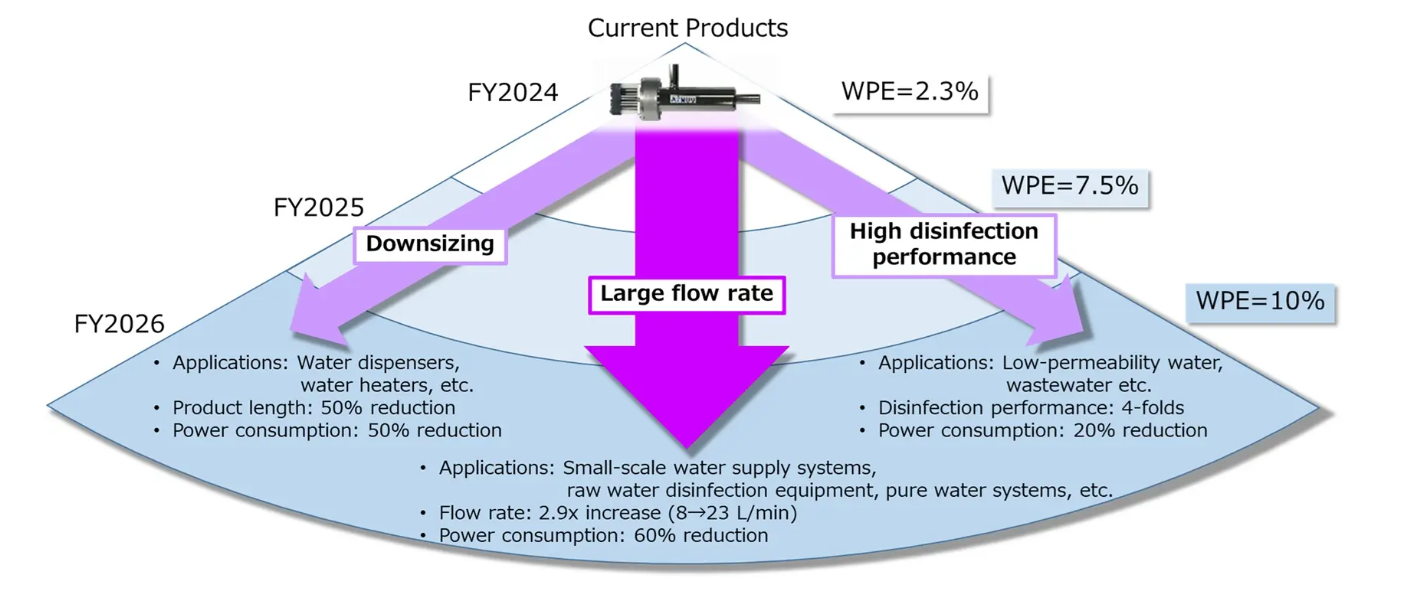
Development direction for our water disinfection reactor (Downsizing, Large flow rate, High disinfection performance)
It is reported that currently, one quarter of the world's population (approximately 2.1 billion people) lacks access to safely managed drinking water (Progress on Household Drinking Water and Sanitation 2000–2024, WHO and UNICEF, 2025). Stanley Electric will continue to pursue ‘high disinfection performance and reliability’, driving the development and performance enhancement of UV-C LEDs at 265nm, where disinfection efficiency is highest. Through light technology, we aim to achieve both a safe and secure water supply and a reduction in environmental impact, thereby solving water-related societal challenges and realizing a sustainable society
Furthermore, this development will expand the application areas and business opportunities for our UV business and products, thereby further strengthening our growth foundation.
TrendForce 2026 Deep UV LED Market Trend and Product Analysis
Release: 31 March 2026
Language: Traditional Chinese / English
Format: PDF / EXCEL
Page: 80
|
If you would like to know more details , please contact:
|


