As the AI glasses market stands on the brink of a major breakout, mass production and full-colorization of Micro-LED displays remain two of the industry’s toughest hurdles. In which ,Qiushui Semiconductor – the first company in the world to pioneer a Damage-free technology for Micro-LEDs – has completed both its Pre-A and A funding rounds recently, raising a combined total of nearly RMB 200 million (approx. 28 million USD)
The capital will be channeled primarily into building an 8-inch hybrid bonding mass-production line in Ningbo. By doing away with traditional plasma etching altogether, Qiushui tackles the problem of light-emitting material damage right at the source, delivering a revolutionary answer for high-volume Micro-LED manufacturing and a long-awaited breakthrough in red Micro-LED efficiency.
The round was led by Zhaohui Capital, with participation from Tongshang Fund, Shengyu Investment, Ningbo Talent Development Fund, Jiayi Venture Capital, Yongxian Technology, Digital Optoelectronics and Xingtang Capital. Xingtang Capital served as the long-term financial advisor.
01 A World-First Technology Powering the “iPhone Moment” for AI Glasses
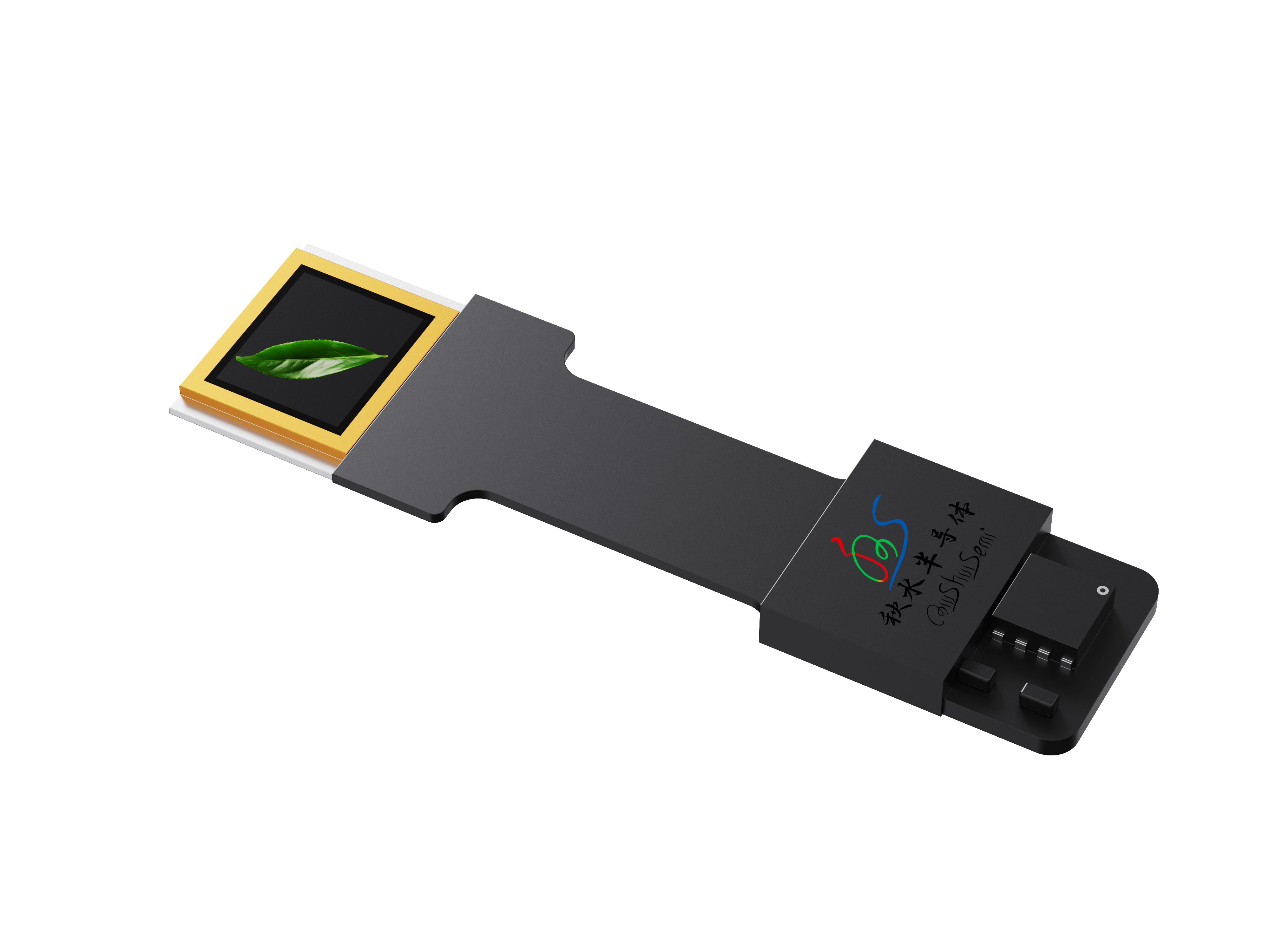
Qiushui’s Leyu AR module
The AI glasses market experienced an explosion in 2025. According to the latest Omdia figures, global AI glasses shipments hit 8.7 million units in 2025, a 322% leap year-on-year. The share of smart glasses that actually carry a display has already jumped from 3.3% in 2024 to 8.4%. Yet Micro-LED – widely regarded as the ultimate next-generation display technology – remains stuck in the bottlenecks of mass production and full colorization.
In the Adaptive Driving Beams (ADB) market, TrendForce analysis indicates that the penetration of ADB is expected to reach 21.6% by 2029, and carmakers such as Porsche have already started to roll out headlight solutions built on Micro-LED pixel modules.
No matter it is AI glasses or ADB, the chip-level mass production bottleneck is the single biggest barrier holding back commercial deployment.
Traditionally, the industry has relied on a dry etching process to physically isolate Micro-LED pixels – imagine trying to dice ultra-fine light-emitting crystals with a “coarse blade”, inevitably causing severe material damage along the edges. The damage not only leads to low yield, higher leakage current and reliability issue, but also causes the efficiency of GaAs epitaxial chips to plunge by more than 97% as the pixel size shrink to 4 micros. This efficiency gap is the real chasm blocking full-colorization displays, and the biggest obstacle to mass production across the downstream supply chain.
To overcome this challenge, Qiushui Semiconductor, founded in November 2022, has developed a disruptive solution: it drops dry etch completely and, through a proprietary chip architecture, builds an invisible “electrically insulating wall” between pixels. This world-first Damage-free architecture achieves electrical isolation for every pixel without ever damaging the physical structure of the material.
With the light-emitting material left intact, optical efficiency is preserved to the fullest. Paired with an 8-inch silicon substrate and a hybrid bonding 3D packaging process – where wafers are joined through both dielectric and metal interconnects – Qiushui’s approach can make chip yield reach to 6N and beyond (99.9999%), narrow the emission angle from ±60°down to ±10°, and stretch the operating temperature range from below 50°C to above 140°C. This marks a definitive escape for the Micro-LED chip industry from the shackles of etching-induced material damage.
Leveraging the mature AlInGaP epitaxial material system, Qiushui can rapidly move to volume production of red light Micro-LED chips. The company has reportedly already qualified its 8-inch hybrid bonding process for devices and will begin volume production within this year. What’s more, solving the etching-damage problem puts Micro-LED pixel scaling on a Moore’s Law trajectory: pixel dimensions can now shrink from mainstream 4 µm down to 2 µm, and eventually into the sub-micron range – precisely what is needed for lightweight, high-resolution AI glasses. It is worth noting that sub-2 µm pixels were long been regarded as the forbidden city for the Micro-LED realm, but not for the IC world; the damage-free architecture tears down that wall. At the same time, by eliminating etch-induced damage and leakage paths, the reliability of both automotive standard and consumer electronic products gets a significant boost.
02 Dramatic Per-Die Cost Reduction, 8-Inch Line to Enter Production This Year
No matter how good the technology looks on paper, the real game is on mass production. The industry is now pivoting toward 8-inch wafer-level hybrid bonding, but very few companies have truly tamed the entire production chain. Qiushui Semiconductor is the first startup in China to have fully qualified an 8-inch hybrid bonding process flow.
When it comes to the competitive landscape in China, different paths have emerged in the Micro-LED chip arena. Unlike players pursuing an asset-heavy IDM model – with lengthy fab construction cycles and intense capital pressure – Qiushui has adopted a Fab-lite model. The company concentrates on building critical process steps, such as hybrid bonding loop, which lacks mature foundry services, thereby keeping its core processes firmly under control.
This model gives Qiushui exceptional agility: it can tailor designs to meet the bespoke needs of a wide range of customers while scaling up rapidly. The company is currently constructing an 8-inch hybrid bonding production line in the Ningbo High-Tech Zone, which is expected to be fully up and running by October this year.
QiuShui’s Founder Dr. Jiang Zhenyu projects that shipments of display-equipped AI glasses could vault from today’s hundreds of thousands of units to the ten-million level within the next year. Once the line enters production, the Ningbo fab will be able to turn out over 1,000 8-inch wafers per month, equivalent to an annual supply capacity of over 10 million Micro-LED chips – enough to underpin the volume requirements of top-tier device makers today.
On the product side, Qiushui has already introduced a 0.61-inch ADB chip that has completed customer sampling and validation. In parallel, monochrome AR red, green and blue (R/G/B) chips are scheduled to enter high-volume shipment this year. Dr. Jiang notes that green monochrome chips already satisfy specific applications such as teleprompters, real-time translation, in-car navigation and smart swimming goggles, while combining monochrome R/G/B chips with a trichroic optical engine can unlock full-colorization applications at scale.
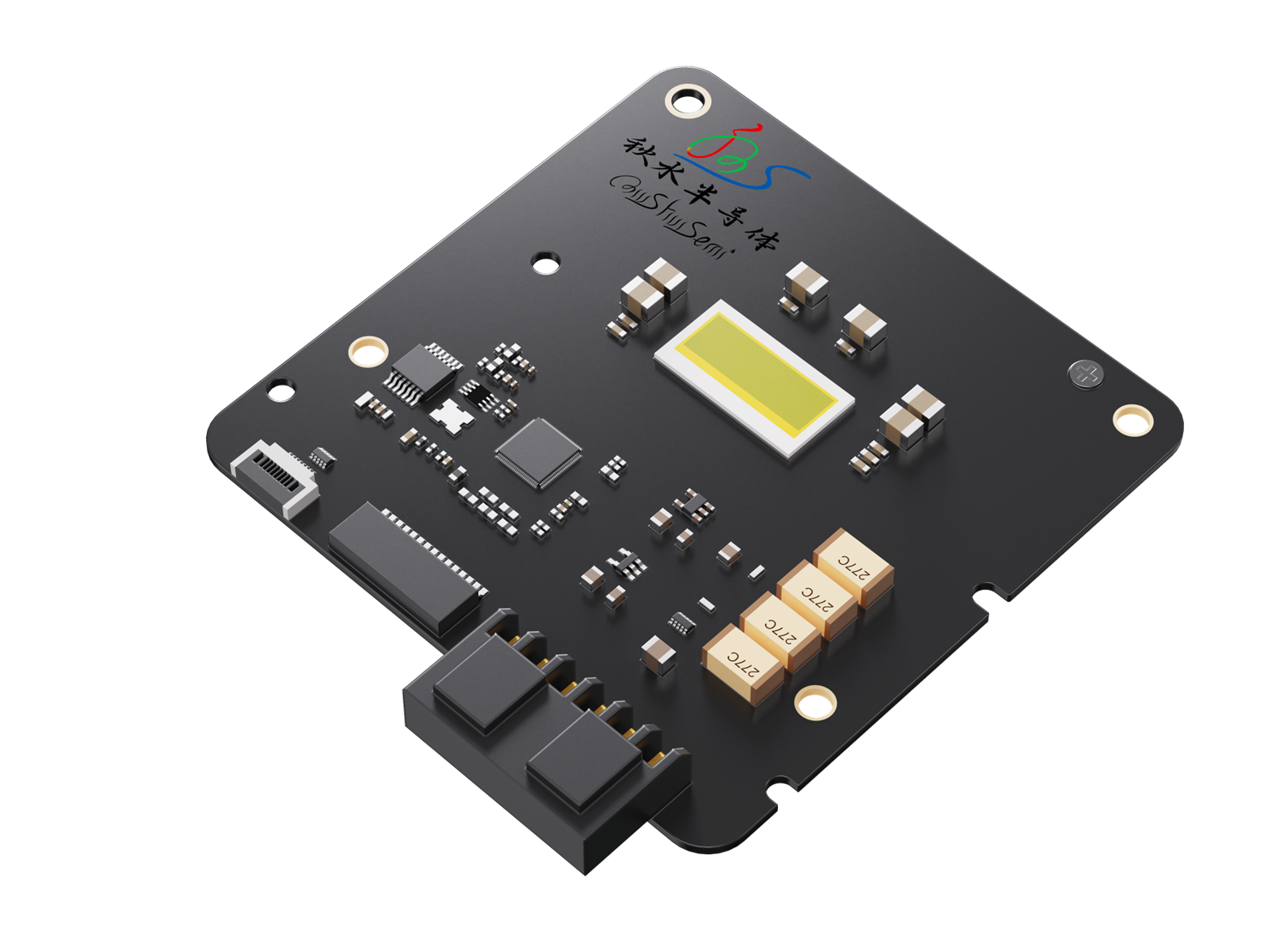
Qiushui’s Hebo Intelligent Headlight Module
Team side: Founder Dr. Jiang Zhenyu is a member of the expert panel for the Ministry of Science and Technology’s Major Project on Novel Displays. He holds a Ph.D. degree from The Pennsylvania State University and has 15 years of R&D and team management experience. He previously served as Senior Scientist at Dalian Eti Optoelectronics, R&D Director at Foshan Nationstar Semiconductor, and R&D Director at the Shenzhen Institute of Wide-bandgap Semiconductor. Co-founder Dr. Wang Haifeng possesses eight years of startup experience in high-power LED automotive lighting. Core team members have held positions at Huawei HiSilicon, Yangtze Memory Technologies Co. (YMTC), Intel and other industry leaders, All of which deep expertise in hybrid bonding and advanced packaging in the previous working experience.
Qiushui Semiconductor is not just making a chip. It is laying the foundational infrastructure for the coming “iPhone moment” of AI glasses. Through a series of core technology breakthroughs, the company is acting as a true pioneer – reshaping the Micro-LED industry and contributing its own unique “Qiushui Solution” to the dynamic rise of the microdisplay world.


